The phone rings while you are under the hood
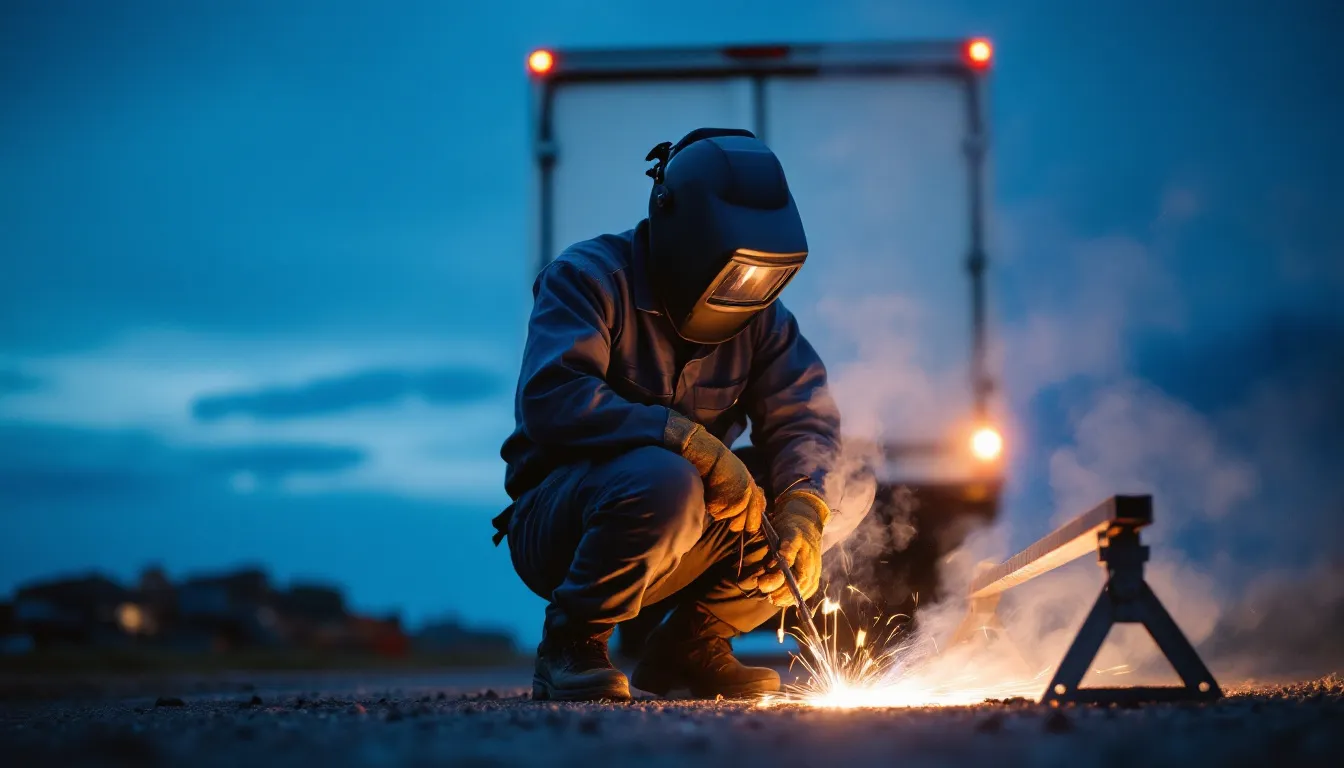
Mobile welding has a scheduling problem that most trades do not. When you are actually working, your face is behind a hood, your hands are occupied, your hearing is compromised, and the arc is not something you can politely step away from mid-bead. The phone is in the truck. It rings, it stops, and forty minutes later you look at three missed calls and a voicemail from someone who already called two other welders.
As of September 2026, the mobile welding and fabrication shops that stay booked are not the ones with the best cap-and-fill. They are the ones that stopped requiring a human being to be free in order for a customer to be captured, qualified, and quoted. This guide walks through the whole operational stack for a mobile welding business: photo-first intake, quoting from images versus selling an assessment visit, qualifying site and safety conditions before the truck moves, travel and minimum pricing, repeat industrial accounts, deposits and progress billing on multi-day fabrication, and the after-hours emergency that stops somebody's production line. It runs on the Run with Jarvis platform.
Why welding intake is a photo problem, not a phone problem
Almost every other trade can be triaged verbally. A plumber can hear "the water heater is leaking from the bottom" and know most of what happens next. A locksmith can hear a year, make, and model. Welding does not work that way, because the words a customer uses do not carry the information that determines the price.
A customer says "the gate broke." That single sentence covers a hinge that pulled out of a post, a cracked weld on a frame corner, a bent picket, a snapped latch, and a gate that a truck backed into and folded. Those are a thirty-minute job and a two-day job and everything between. No amount of careful phone questioning gets you there reliably, because the customer does not know which details matter.
So the intake has to collect images, and it has to collect them before anyone commits to a price or a drive. The system that answers the call should text a link back to the caller within seconds, asking for a specific short list rather than "send me some pictures":
- A wide shot showing the whole assembly, not just the break, so you can see how the piece is loaded and what it is attached to.
- A close shot of the damaged area with something for scale in frame, a tape, a coin, a glove.
- A shot of the approach, meaning how close a truck can park to the work.
- A shot straight up and straight down from the weld area, because what is overhead and underfoot decides whether this is routine or a fire-watch job.
Alongside the photos, the intake collects the facts that photos cannot show. What is the material, and if the customer does not know, what does a magnet do. Roughly how thick is it, and here the useful question is comparative rather than numeric, is it thinner than a coin, about like angle iron on a trailer, or heavy plate. Is the piece holding weight or holding a person, which is the plain-language way of asking whether it is structural. Is there power on site, and if so, is it a household outlet or a real circuit. Is the equipment shut down and cool, or is it still in service. Can you get a truck within reach, or is this a carry-in with a portable rig.
None of those questions require a welder to ask them. They require somebody to ask them every single time, in the same order, and to keep asking when the caller answers vaguely. That is exactly the work an AI receptionist does well and a tired owner does inconsistently.
The layer that answers: intake that runs while the arc does
The foundation is KeyBot, the AI phone agent that answers on the first ring in English or Spanish, at any hour, and runs your intake script without deviation.
For a one-truck or two-truck welding operation, that is not a convenience. It answers three calls arriving during a single repair, in parallel, which no human receptionist does. It answers at 9 PM when a farmer discovers a cracked hitch the night before harvest work. And it answers with identical thoroughness on the fourth job of a hot day, which is the exact moment human intake quality collapses.
It also texts. The single most valuable action in a welding intake is sending the photo request while the caller is still thinking about you, and doing it in the first sixty seconds. An automatic text reply to every call, answered or missed, is close to its strongest use case in this trade, because your customer physically has the photos on their phone and will only take them while motivated.
The same intake discipline shows up in every mobile trade where the operator is physically unable to answer. The parallel case for the automotive side is in the mobile mechanic stack, and the structure is nearly identical: the operator cannot be the intake path, so the intake has to exist without them.
Quoting from photos versus selling the assessment visit
Once the photos arrive, welding work sorts into three quoting categories, and the mistake most shops make is treating all three the same way.
Firm-quotable from images. Repeat, well-understood work where the photos genuinely tell you what you need: a standard handrail section, a trailer fender bracket, a common hitch repair you have done fifty times, a fence gate hinge on a residential post. You have done the job enough times that your uncertainty is small, and quoting it on the spot is a real competitive advantage, because the other three welders the customer called all said "I would have to come look at it."
Banded, with a stated condition. You can give a range and name exactly what would push it to the top of that range. "Between these two numbers if the crack is only in the plate you photographed; if the tube behind it is also cracked, we are into a section replacement and that is a different job." Customers accept banded quotes far better than most operators expect, provided the condition is specific rather than a general disclaimer. What they will not accept is a firm number that changes on arrival.
Assessment visit required, and charged. Structural repairs, anything on equipment that carries load or people, corrosion of unknown extent, anything inside a live plant, and any job where the customer's photos show you a symptom of a failure you suspect is larger. Here you sell an assessment visit as a product: a fixed fee for a competent on-site evaluation, a written scope, and a firm quote, with the fee applied against the work if they proceed.
That last framing is doing all the work. Charged badly, an assessment fee reads as a toll for showing up. Charged well, it reads as a deposit, and it also filters out the caller who was never going to buy. Delivering that framing consistently on every call is precisely where automation beats improvisation, and it is the same conversation pattern as the one in handling price shoppers on the phone.
There is a fourth category worth naming: the job you should decline on the phone. Certified structural work you are not certified for, pressure-retaining components, anything requiring inspection or documentation you do not provide, aluminum or exotic material you are not tooled for, and jobs at a height or in a space you are not equipped and trained to enter. A well-built intake identifies those and says no in the first two minutes, which is worth as much as booking a good job, because a declined job at intake costs nothing and a declined job in a customer's yard costs half a day.
Qualifying the site before the truck moves
Mobile welding is hot work performed in places that were not designed for hot work, and the conditions on site are not incidental details. They determine whether the job takes ninety minutes or gets abandoned. They belong in intake, phrased as things you need to know, not as advice you are giving the customer.
The qualifying questions that pay for themselves:
Does the facility require a hot work permit, and who issues it. On any industrial, commercial, warehouse, school, or institutional site, the answer is often yes, and the permit takes time the customer has not accounted for. Discovering that on arrival costs you the slot.
Who provides fire watch, and for how long after the work stops. Many facilities require a dedicated person watching the area, and many expect the contractor to supply them. If your intake does not ask, you find out standing next to the work.
Is any part of this a confined space, a tank, a pit, a vessel, a crawl area, a silo. If the honest answer is yes, that is a different job with different equipment, different staffing, and different requirements, and you decide whether you take that work at all, not on site.
What is above, below, and behind the weld. Sprinkler heads, wiring, hydraulic lines, fuel lines, insulation, painted or coated surfaces, stored product, a floor above with something combustible on it. The photo of the surroundings you requested at intake exists for exactly this question.
Is the equipment shut down, isolated, cool, and empty, and who is responsible for making it so before you arrive. Anything that held fuel, oil, chemicals, or gas gets its own set of questions, and if you do not do that class of work, intake should say so.
Is the site occupied and operating while you work. Welding over a live retail floor, an occupied restaurant kitchen, or a running production area changes the scheduling and often pushes the job to nights and weekends, which changes the price.
None of that is regulatory guidance, and none of it substitutes for the requirements your customer's facility, your insurer, and your jurisdiction actually impose. It is a checklist of things you must know before committing a truck and an afternoon. The Small Business Administration publishes general business material at sba.gov, but the specific hot work requirements on any given site come from that site and the applicable authority, not from a phone script.
Travel, minimums, and the truck that is the shop
A shop welder's overhead sits in a building. Yours drives. Every mile between jobs is unbillable, the rig burns fuel whether or not you are striking an arc, and the consumables ride with you.
That produces two pricing rules that mobile welding needs and shop welding does not.
The first is a service minimum. There has to be a number below which the truck does not roll, and that number should be stated during intake, not discovered at the end. The caller who wants "just a quick tack, it will take you two minutes" is asking you to spend an hour of drive time for two minutes of arc, and the minimum is how you answer that without arguing. Published early, it converts the tire-kicker into either a real job or a fast no.
The second is a travel structure that reflects real drive time rather than map miles. Twelve miles across a downtown core at four in the afternoon is a different cost than thirty miles of rural highway. The reasoning and the common structures are laid out in the service radius and drive-time pricing guide, and mobile welding is one of the trades where getting it wrong is most expensive, because your jobs are long enough that you only fit two or three in a day and a bad third one eats the margin from the first two.
Booking is where this gets enforced. GetTimePad holds real availability so the intake books against your actual day instead of promising a callback, and dispatch adds GPS tracking, route optimisation, and automatic arrival texts so the customer stops calling to ask where you are while you are driving to them.
Whether any of this is actually working is a job costing question, not a feeling. Track material, consumables, gas, drive time, and on-site hours against each job and the picture gets uncomfortable fast, usually revealing that the small residential repairs you take out of politeness are the ones losing money. The method is in job costing and profit per job.
Repeat accounts versus one-off gates
Mobile welding revenue splits into two populations that behave nothing alike.
One-off residential work is railings, gates, fence repairs, trailer fixes, decorative pieces, and the cracked bracket on a homeowner's mower deck. Ticket sizes are modest, price sensitivity is high, the customer usually does not know what welding costs, and the acquisition cost per job is the whole problem. These jobs are worth taking, but they are worth taking efficiently, batched geographically, and quoted quickly, and they are not worth chasing with a callback tomorrow.
Farm, fleet, and industrial accounts are the opposite in every dimension. A trucking yard, a farm operation, a rental fleet, a manufacturer, or a municipal maintenance department calls repeatedly, has real budget, cares more about response time than price, and produces predictable revenue. One good industrial account can outweigh dozens of gate repairs.
The operational implication is that your intake must recognise which one it is talking to, immediately. A fleet manager whose trailer is down is not price shopping, they are asking when. Making them wait through a residential-style qualification script, or worse, letting them hit voicemail, is how those accounts get lost to whoever answered.
The system supports that in two ways. The CRM holds the account, its equipment, its site conditions, its permit process, its preferred contacts, and every prior repair, so a returning caller is recognised rather than re-interviewed. And the intake can route recognised account numbers straight to urgent handling while a new residential caller gets the full photo-and-qualification sequence.
Holding those accounts over time is a relationship problem with an operational answer. Standing arrangements, scheduled inspection visits, and agreed response commitments turn irregular repair work into something closer to recurring revenue, and the account history that makes those arrangements possible only exists if every call against that account was captured in one place. That is also where job costing earns its keep, because an account is only worth holding if you know what serving it actually costs.
Multi-day fabrication: deposits and progress billing
Fabrication is a different business than repair, and it needs different money handling.
The moment you accept a fabrication job you spend money. Material is bought, cut, and increasingly worthless to anyone else the further you take it. A custom stair stringer set, a bumper, a set of gates, a mezzanine platform, a run of racking, all of it consumes capital days or weeks before a single hour is billable. A fabrication job accepted with no deposit is a job where you have loaned your customer the material cost, interest free, on nothing but their word.
The structure that works is simple and should be stated the same way every time. A deposit at order that covers material and a meaningful share of the expected labour, taken before anything is cut. Progress payments tied to named, visible milestones rather than dates, because "material received and cut" and "fabrication complete, ready for finish" are events the customer can verify and a date is just a calendar entry. A final balance at installation or delivery.
Every one of those should go out as a payment link the customer taps on a phone, not an invoice mailed into a payables process. The stack invoices from the job, supports three payment providers, syncs bidirectionally with QuickBooks so the books are not a month-end reconstruction, and includes chargeback defence. The full argument for link-based collection is in getting paid faster with payment links, and for fabrication the effect is larger than for repair, because the amounts are larger and the delay is longer.
Change orders deserve the same treatment. Fabrication scope moves, and it moves in conversation, in a yard, verbally. Every scope change should produce a written record and, where it is material, its own approval and its own payment step. A fabrication business with no change-order discipline is a fabrication business that eats every revision it agreed to on a job site.
The CRM and POS side of that lives in IntelliDrive, which holds the customer, the job record, the invoicing, and the payment history in one place rather than across a notebook, a texting thread, and an accounting package.
The night the production line stops
The highest-value call a mobile welder receives is the one at 11 PM from a plant where something structural failed and the line is down.
That caller is not price shopping. They are running a mental cost of downtime per hour that dwarfs your invoice, and they are dialling shops in sequence until a human being responds. The first competent answer wins the job, and often the account behind it.
Voicemail loses that call entirely. A phone that rings out loses it faster. What wins it is an immediate answer that sounds organised: what plant, what equipment, what material, is it shut down and isolated, can we get a truck to it, do you have a hot work permit process at this hour, do you have fire watch, who is the on-site contact and what is their number. Then an escalation to you with all of that already collected, so your first words to the customer are about the repair rather than about who they are.
That is also the moment to be honest about what you will not take on. A structural repair on a machine that carries load, at night, with a plant desperate to restart, is exactly the situation where a shop agrees to something it should not. An intake that captures the facts and hands you a clean decision is worth more than one that books everything.
How the four job types should actually be quoted
| Job type | How it should be quoted | What must be captured at intake | The usual way it goes wrong |
|---|---|---|---|
| Emergency repair, down equipment or production line | Time and materials against a stated call-out minimum, with an after-hours rate named on the call | Site and contact, equipment and material, whether it is isolated and cool, truck access, permit and fire watch availability, who authorises spend | Nobody answers, or a firm price is promised at night and revised on arrival in front of a plant manager who is already losing money |
| Mobile repair on site, scheduled | Firm from photos when the work is familiar, banded with a named condition when it is not, otherwise a charged assessment visit | Wide and close photos with scale, material and rough thickness, structural or not, parking and approach, power availability, what is above and below | Quoted blind over the phone from the customer's description, then the crack turns out to run into a member you could not see |
| Shop fabrication, multi-day | Fixed price from a written scope and drawing, with a material deposit at order and progress payments at named milestones | Dimensions and drawings or measured photos, material and finish, mounting and load expectations, delivery or install scope, site access for install | No deposit taken, so material is funded out of working capital, and verbal change orders absorb the margin before invoicing |
| Ongoing farm, fleet, or industrial account | Agreed labour rate plus materials under a standing arrangement, with a response commitment and periodic review | Account and site records, equipment list, recurring failure history, permit process, authorised contacts, purchase order requirements | Treated as a series of unrelated one-off calls, so the account is re-interviewed every time and eventually goes to whoever answered faster |
Running the numbers on a one-truck operation
Treat these figures as an illustration to replace with your own.
Assume a mobile welding operation completes 30 billable jobs a month at an average ticket of $620, which is $18,600 in monthly revenue. Assume the phone rings 110 times a month, and because most of the working day is spent behind a hood, 40 of those calls go unanswered and roughly half of the missed callers never come back.
Assume conservatively that only 3 of those missed calls would have become jobs. At $620 that is $1,860 in recovered monthly revenue. Core at $500, plus 100 overage minutes at $0.45, which is $45, comes to $545. The recovered revenue is more than three times the subscription cost before counting anything else the stack does.
The second number matters more for a solo operator. If intake, callbacks, quoting, and chasing invoices currently consume two hours of your day, and your billable rate is $110 an hour, that is $220 a day of capacity you are spending on administration. Recovering even half of it exceeds the subscription by a wide margin.
On minutes: Core includes 500 AI call minutes. A welding intake call runs longer than most trades because of the material, access, and site questions, so budget five to seven minutes. At six minutes, 500 minutes covers roughly 83 calls, with the balance at $0.45. At 110 calls a month you are looking at about 160 overage minutes, roughly $72. Above about 1,100 minutes a month, Pro's 1,000 minutes at $0.40 becomes the cheaper structure and adds call recording, transcription, and ad attribution on top. Plan details are on the pricing page.
Rollout order
Start with answering and the photo request. Nothing else in this stack changes your week as much as every caller reaching a real intake and receiving a photo link within a minute. Run that alone for two weeks and look at how many quotes you are producing from your truck seat between jobs.
Add booking, dispatch, and arrival texts next. That removes the "where are you" calls and puts the day in one place so you can see what an emergency actually displaces before you agree to it.
Then add invoicing with payment links and the deposit structure for fabrication. Collect on site or at milestone, not afterwards.
Then turn on outbound follow-up so quotes that went quiet get a second touch without you remembering. The platform's AI outbound follow-up calls work on your own leads and customers, meaning stalled quotes, unpaid invoices, and accounts that have gone dormant. See pricing for how that sits across the tiers.
Only after those are running should you think about attribution and marketing tooling. Measuring which ad produced a call is a useful exercise once you are answering the calls; it is a documentation exercise while you are still missing forty a month.
The short version
Welding intake is a photo problem. The customer's words do not carry the information that sets the price, so the system has to collect images, material, thickness, access, structural status, and site conditions before anyone commits to a number or a drive.
Quote firmly what you genuinely know from images, band what you can with a named condition, and sell a charged assessment visit for everything structural or unknown. Publish a minimum so the truck does not roll for a favour. Price travel on real drive time. Recognise your farm, fleet, and industrial accounts on the first ring and treat them differently from a one-off gate. Take a material deposit and bill fabrication against milestones. Answer the down-line call at 11 PM, because that one call is often an account.
If you want that modelled against your real call volume and average ticket, get in touch or look at the plan details on the pricing page.