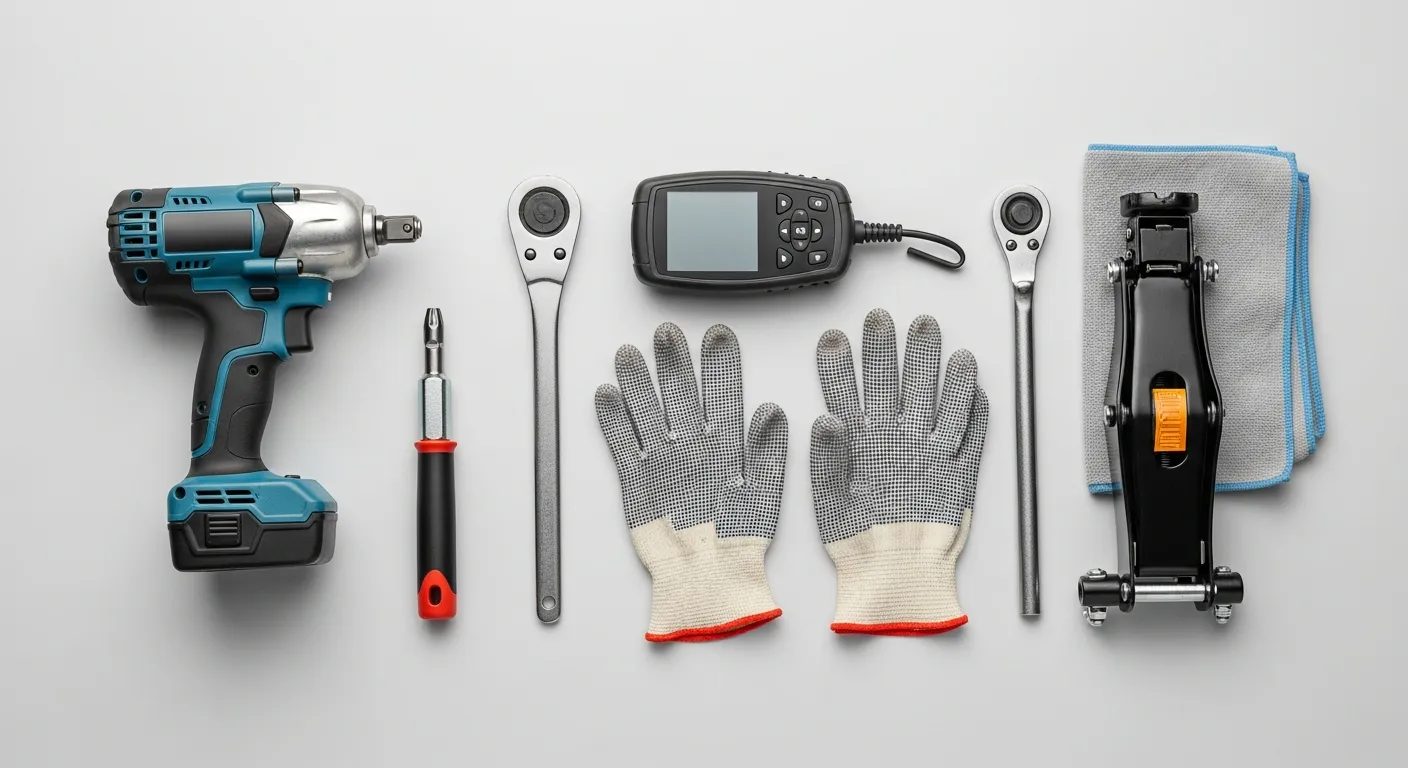
One person, one van, one phone that never stops
The mobile mechanic business has a structural problem that shop-based repair does not. A shop has a service writer. Somebody stands at a counter, answers the phone, writes tickets, and calls customers with estimates while technicians turn wrenches in the back. That division of labor is the whole reason a shop can handle volume.
A mobile mechanic has none of that. The same person is the technician, the service writer, the dispatcher, the parts buyer, the estimator, and the collections department. And the technician half of that job involves lying under a vehicle with a torque wrench, in a driveway, with grease on both hands, which is a physical state in which answering a phone is not a decision you get to make.
As of July 2026, the mobile mechanics who are booked out two weeks are not the ones who are better at diagnostics. They are the ones who stopped requiring themselves to be available to answer the phone. This guide covers the full stack: answering, triage between roadside and driveway work, quoting, the diagnostic fee conversation, parts capture, dispatch, payment at the curb, and reviews. It all runs on the Run with Jarvis platform.
Where mobile repair loses money that a shop does not
Every answered call costs you billable time, and every unanswered one costs you a job. In a shop, answering the phone is somebody's job. For you, answering the phone means setting down a tool, degreasing your hands, and losing ten minutes of a job the customer is watching you perform. So you let it ring, and the caller dials the next mobile mechanic on the search results page. There is no good option in that tradeoff, which is why the answer is to remove the tradeoff.
Roadside calls have a shelf life measured in minutes. Someone stranded in a parking lot with a car that will not start is calling in sequence until somebody answers. They are not leaving voicemails. If you are the third listing they call and the first one picked up, you never existed to that customer. The general math on this is in the speed-to-lead guide, and it is more severe for roadside than for almost any other service call type.
Parts delays turn one trip into two. You arrive, diagnose, discover the alternator is the problem, and now you are driving to a parts store or ordering something that arrives tomorrow. The customer sits with a dead car and you have spent a slot to produce a diagnosis instead of a completed repair. The information needed to prevent that, meaning year, make, model, engine, VIN, and symptom, was available during the first phone call and nobody captured it.
The diagnostic fee kills calls before they start. "How much to come look at it?" is the most common question a mobile mechanic gets, and it is the question most likely to end the call badly. Handled poorly, the customer hears a toll for showing up. Handled well, it is a deposit against the repair.
Getting paid depends on being physically present. You do not have a counter, a card terminal on a wall, or a customer who has to come pick their car up before paying. If the payment does not happen at the curb, it becomes a chase.
Each of those has a layer.
Layer 1: An AI receptionist that answers while your hands are dirty
The foundation is KeyBot, the AI phone agent. It answers on the first ring, in English or Spanish, at any hour, understands what is wrong with the vehicle, asks your intake questions, quotes when your pricing supports it, books the visit, and texts a confirmation.
For a solo operator this is not a convenience feature, it is the thing that makes the business scalable at all. It answers in parallel, so three calls arriving during a single brake job all get handled. It answers at 10 PM, when a customer whose car died in a work parking lot is deciding who to call in the morning. And it answers identically every time, which means your intake quality does not degrade on the days you are exhausted.
Bilingual coverage is not optional in most metro markets for this trade. A Spanish-speaking customer describing a starting problem should be able to do it in Spanish rather than finding someone to translate for them. That is on every plan at no extra cost.
For a one-van operation, hiring a service writer is not on the table, and a traditional answering service that takes a message and hangs up solves the wrong half of the problem. You still have to stop working, wash your hands, call back, quote, and book, which is the expensive part.
Layer 2: Triage between roadside and driveway work
Mobile repair splits into two operating modes that need different handling, and the intake has to tell them apart.
Roadside and no-start work is urgent, unscheduled, location-sensitive, and often ends up being a jump, a battery, a starter, an alternator, or a tow recommendation. It has to be triaged fast: is the vehicle in a safe location, is it drivable, what happened right before it stopped, does anything come on with the key. It may need to displace something else on today's schedule, and it may need to be declined if it is genuinely a tow.
Scheduled driveway work is planned maintenance and repair at a home or workplace: brakes, fluids, sensors, belts, batteries, suspension. It is flexible about timing, which makes it the material you use to build a dense route.
The AI runs the same triage questions every time, captures location, vehicle details, and symptom, and routes the call to the right shape of appointment. That consistency is what lets you trust the record when you look at it between jobs. The logic behind how the system judges what a caller actually needs is in the lead scoring guide.
It also has to know what to decline. A transmission rebuild, a job requiring a lift, a vehicle in an underground garage with no clearance, or a repair that needs a full day of shop equipment should be identified on the phone, not in a driveway forty minutes away. A well-configured intake refuses work you cannot do, which is worth as much as booking work you can.
Layer 3: Capturing parts information during the first call
This is the layer most mobile mechanics skip and the one that changes daily throughput the most.
The parts problem is a sequencing problem. You cannot order a part you have not diagnosed, but you can dramatically narrow what you are likely to need if the intake captures year, make, model, engine size, trim, VIN when the customer can read it off the dash or door jamb, mileage, the symptom in the customer's own words, any warning lights, and any codes if the customer has already had them pulled at a parts store.
With that in hand before you arrive, you can pre-stage the common failure parts for that vehicle and symptom, or at minimum confirm availability so that if the diagnosis lands where you expect, the part is thirty minutes away instead of tomorrow. That is the difference between a diagnostic call and a completed repair.
An automated intake collects those fields on every call without fail, which a rushed human intake at the end of a hot day does not. And the details land attached to the customer record, so the second time that vehicle comes up you already have the VIN and history rather than asking again.
Layer 4: Quoting, and defending the diagnostic fee
Mobile repair quoting splits cleanly.
Some jobs are quotable on the phone with confidence: battery replacement, brake pads and rotors on a common vehicle, an oil service, a serpentine belt, a starter on a model you have done fifty times. For these, year, make, model, and job type give you a number, and your pricing rules can produce it. Quoting these immediately is a large competitive advantage, because most mobile mechanics answer with "I would have to look at it," and the customer who wanted a number goes elsewhere.
Other jobs are genuinely not quotable: an intermittent electrical fault, a check engine light with no code read, a noise the customer describes as "kind of a clunk," an overheating problem that could be five different things. Quoting these on the phone is how you end up in a driveway explaining why the number changed, which is the fastest way to lose a customer permanently.
Which brings us to the diagnostic fee, the single most consequential thirty seconds in a mobile mechanic's phone call.
The objection is real and the customer's version of it is reasonable: they do not want to pay someone to show up and tell them something is broken. The framing that works is that the fee buys a real diagnosis performed at their location, that it is applied toward the repair if they proceed, and that it prevents the far more expensive outcome of guessing at parts. Delivered that way, the fee reads as a deposit. Delivered as "it is $95 just to come out," it reads as a toll.
The advantage of automating this is consistency. You will deliver that explanation well when you are fresh and badly when you are on your fourth job of a hot day. An AI receptionist delivers the same version at 8 AM and 11 PM, on every call, forever. That is a meaningful conversion difference across a year, and it is the same reason handling after-hours calls systematically outperforms handling them heroically.
Layer 5: Booking a route that a single van can actually drive
GetTimePad holds your real availability so the AI books against open slots during the call rather than promising a callback.
The routing constraint for a solo mobile mechanic is brutal and simple: you are one vehicle, and every mile between jobs is unbillable. A day with four jobs spread across a metro area is a day with two hours of driving and a lot of stress. A day with four jobs inside a six-mile radius is a comfortable, profitable day.
Because scheduled driveway work is usually flexible on date, the booking layer should be steering those customers toward days when you are already working near them. This is the same density principle that route-based trades live on, and it works exactly the same way here as it does in the pool service stack. The difference is that with one van, you have less slack to absorb a bad route, so it matters more.
Dispatch then handles the rest: GPS tracking, automatic ETA and arrival texts so customers stop calling to ask where you are, and job details in your hand instead of in a text thread you have to scroll back through. The mechanics of that layer are in CRM and dispatch for multi-tech service businesses, and it applies to a single-tech operation just as directly.
Roadside emergencies break the plan by nature. The value of having the day visible in one system is that you can see what displacing a scheduled job actually costs and make a real decision, then push the displaced customer to a new slot automatically rather than calling them from the roadside.
Layer 6: Getting paid at the curb
There is no counter and no held vehicle. If money does not change hands before you leave, you are now a creditor.
The stack invoices from the completed job and texts a payment link the customer taps on their phone while you are packing tools. Three payment providers are supported, QuickBooks sync is bidirectional so your books are not a monthly reconstruction project, and chargeback defense is included, which matters for a trade where a customer occasionally disputes a repair weeks later because a different problem appeared.
For a solo operator, the cash flow difference here is not marginal. Every invoice that leaves unpaid becomes a follow-up task competing with billable work. The full case is in getting paid faster with payment links, and the bidirectional QuickBooks sync means your books are not a month-end reconstruction.
Layer 7: Vehicle history that makes you look like a shop
A repeat customer with three vehicles is worth many times a one-time roadside job, and the thing that keeps them is the sense that you know their cars.
The CRM holds vehicle and service history against the customer record, so when that number calls again the AI already knows which vehicles they own, what you last did, what you flagged as coming due, and what parts you used. The customer does not have to re-explain their own car. You show up already knowing you replaced the front pads eight months ago and noted the rear were at forty percent.
That is what a good independent shop does with a paper file and thirty years of memory. A CRM gives a one-van operation the same effect without either.
Layer 8: Reviews, which are the entire top of your funnel
Mobile mechanic customers find you by searching, and they choose based on reviews because they are about to let a stranger work on their car in their own driveway. Trust is the whole purchase decision.
Review automation asks at the moment the customer is standing next to a car that now starts, which is the only moment they will reliably say yes. Manual review requests do not survive contact with a busy week. The approach is in how to get more customer reviews.
Layer 9: Asking your own business questions in plain English
Once the data is in one place, the useful question stops being "what happened" and becomes "what should I do differently." The Jarvis AI Brain lets you ask operational questions in ordinary language rather than building reports: which days produced the most revenue, how many diagnostic visits converted to repairs last month, which callers never got booked. For an owner-operator with no back office, that is the difference between having data and using it.
What each plan gives a mobile mechanic
| Operational problem | Core ($500/mo) | Pro ($750/mo) | Elite ($1,200/mo) |
|---|---|---|---|
| Calls arriving while you are under a vehicle | 24/7 bilingual AI receptionist, 500 minutes included | Same, 1,000 minutes | Same, 2,500 minutes |
| Roadside urgency and after-hours calls | Answered live around the clock | Included | Included |
| Booking a drivable route | Smart job booking, GPS tracking, route optimization, auto ETA and arrival SMS | Included | Included |
| Vehicle and parts history | CRM plus customer portal, mobile app for iOS and Android | Included | Included |
| Getting paid at the curb | Invoicing, 3 payment providers, QuickBooks sync, chargeback defense | Included | Included |
| Reviews | Review automation for Google, Facebook, Yelp | Included | Included |
| Following up on unclosed quotes | AI outbound follow-up calls | Adds power dialer, softphone, voicemail drop, callback scheduling | Included |
| Knowing which ads produce repair calls | Not included | DNI, Google Ads gclid attribution, Meta attribution, call recording | Included |
| Judging call and lead quality | Not included | AI transcription, lead scoring, sentiment and intent analysis | Included |
| Running marketing and asking the system questions | Not included | Not included | AI campaign builder, landing pages, ad copy and images, Meta ads, Google Business Profile, AI review replies, LSA leads, competitor intelligence, Jarvis AI Assistant |
| Overage rate per AI call minute | $0.45 | $0.40 | $0.35 |
All plans are month-to-month, zero setup fees, unlimited users.
Running the numbers as a one-van operation
Assume a mobile mechanic books 40 jobs a month at a $450 average ticket, which is $18,000 in monthly revenue. Assume the phone rings 130 times a month and, because most of the day is spent working on vehicles, 45 of those calls go unanswered.
Assume conservatively that only 4 of those 45 missed calls would have become jobs. At $450 that is $1,800 in recovered monthly revenue. Core at $500 plus 120 overage minutes at $0.45, which is $54, comes to $554. Recovered revenue is more than three times the cost, before counting faster payment, denser routing, or reviews.
Now consider the version that matters more to a solo operator: time. If answering and intake currently consume ninety minutes of your day across interruptions and callbacks, and your billable rate is $120 an hour, that is $180 a day of capacity. Recovering even half of it is worth more than the subscription by itself.
The minute math: Core includes 500 minutes. A mobile repair intake call typically runs four to six minutes because vehicle details take time. At five minutes, 500 minutes covers about 100 calls, with the rest at $0.45. At 130 calls a month you are looking at roughly 150 overage minutes, about $68. Above roughly 1,100 monthly minutes, Pro's 1,000 minutes at $0.40 becomes cheaper and adds attribution.
The general framework is the same arithmetic any owner can run: recovered revenue from answered calls, minus the plan cost, plus the billable hours you stop losing to intake and callbacks.
Rollout order for a solo operator
Start with answering and booking only. Do not try to configure ten systems in a week while also working full days. Answering alone changes your operating reality within days.
Add dispatch, arrival texts, and payment links next. Those two together remove most of your non-billable phone time and most of your collections work.
Then turn on review automation and outbound follow-up so quotes that went quiet get a second touch without you remembering to make it.
Only after that, if you are advertising, consider Pro for attribution or Elite for campaign management. Measuring ad performance precisely while still missing forty calls a month just documents the leak.
For general small business resources, the Small Business Administration publishes material at sba.gov, and the Federal Trade Commission maintains general consumer and business guidance at ftc.gov. Neither substitutes for your state's specific requirements around mobile repair licensing and written estimates, which vary considerably.
The short version
A mobile mechanic is one person doing six jobs, and the phone is the job that conflicts with all the others. The fix is not discipline, it is removing yourself from the intake path.
Answer every call in parallel and around the clock. Triage roadside from scheduled work. Capture vehicle and parts details on the first call so you arrive prepared. Quote what is quotable and frame the diagnostic fee as a deposit. Book a route one van can actually drive. Collect at the curb. Ask for the review while the customer is standing next to a running car.
If you want that modeled against your real call volume and ticket, get in touch or look at the plan details on the pricing page.