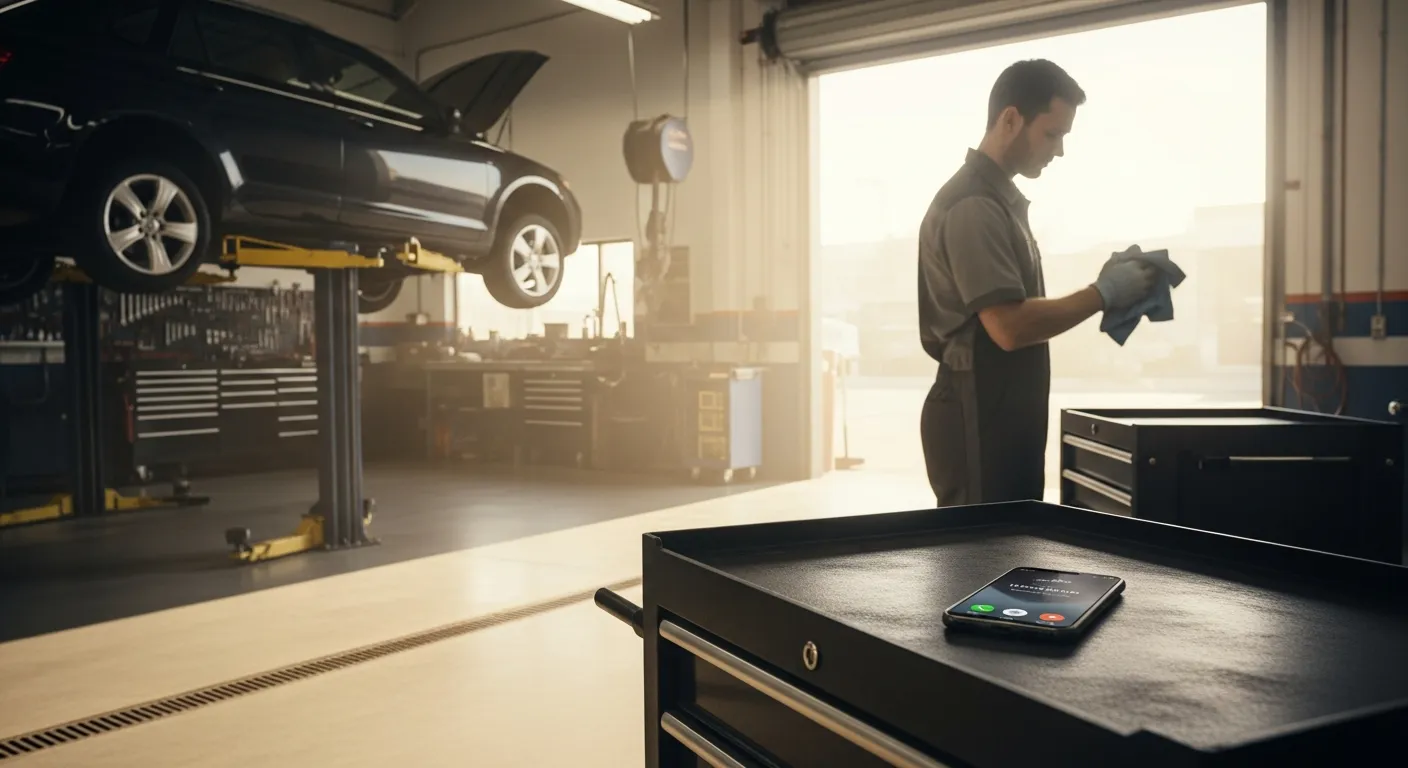
The call you miss with your hands full
A car is on the lift, the tech is halfway through a timing chain job with the front of the engine apart, and the phone at the front counter rings. There is nobody to grab it — the other advisor is walking a customer through an estimate, and the owner is under a different car. Four rings, voicemail, and the caller hangs up. Ninety seconds later they are on the phone with the shop two blocks over that happened to have someone free to answer.
That caller had a check-engine light and a $900 repair attached to it. You never knew they called.
As of July 2026, the independent auto repair shops pulling ahead are not the ones with the flashiest waiting room. They are the ones that answer every call, book the car into an open bay before the customer hangs up, get estimates approved from the customer's phone without phone tag, and quietly follow up on every repair a customer declined last month. That is not a bigger front counter. It is an automation stack — and this guide breaks down exactly how it works for an auto repair business.
If you run a mixed mobile-and-shop operation or a specialty trade, the same logic drives our locksmith automation stack and appliance repair automation guide. The vertical details here are built for shops that turn wrenches.
Why auto repair calls leak revenue
Auto repair has a structural phone problem that most trades share but few feel as sharply, because your revenue producers are the same people you would ask to answer the phone.
- Your best phone-answerer is your best technician. Unlike a trade where the office and the field are separate people, a small shop's service advisor is often also a working tech or the owner. Every call answered is a wrench put down. Every wrench kept turning is a call missed.
- Callers are symptom-shopping and price-shopping at once. A customer with a grinding noise does not know if it is $200 or $2,000. They call three shops, and the one that answers, sounds competent, and offers a real appointment window usually wins the car — long before anyone has looked under it.
- The jobs are high-ticket and repeat. A single diagnostic can lead to a $1,400 repair, and that customer, treated well, comes back for the next four years of maintenance. Missing the first call does not cost you one job; it costs you a relationship.
- After-hours calls go straight to a competitor. A commuter whose car won't start Sunday night is booking Monday morning somewhere. If your line goes to voicemail, that somewhere is not you.
The problem is almost never lead generation. Your sign, your Google profile, and your ads already produce the calls. The problem is lead capture — answering them. We work through that gap in detail in the true ROI of an AI receptionist for service businesses.
The five layers of a fully automated auto repair shop
Run with Jarvis is built from five components that map cleanly onto how an auto repair shop actually runs. You do not need every layer on day one; the plans stack them as your call volume and truck count grow.
- KeyBot — a 24/7 bilingual (English/Spanish) AI phone answerer that qualifies the vehicle and symptom, quotes common services from your price list, and books the car into an open bay.
- GetTimePad — online booking and calendar management, so your open bay slots are visible and reservable in real time, with automatic SMS confirmations.
- IntelliDrive — CRM, POS, invoicing, payment links, parts inventory, and technician dispatch, syncing bidirectionally to QuickBooks.
- CallFlux — call tracking, ad-source attribution, recording and transcription, and lead scoring, so you know which campaign actually filled the bays.
- Jarvis AI Brain — a natural-language command center with 100+ tools that runs autonomous follow-up, declined-work re-offers, and revenue optimization (Elite tier).
If you are weighing this stacked approach against buying five separate tools and wiring them together, our comparison of all-in-one versus point solutions walks through the integration math that independents usually underestimate.
Layer 1: answering the call while the bay is full
The core of auto repair automation is that the phone stops depending on whether a human is free. KeyBot answers on the first ring, every time, whether it is 10 a.m. with both advisors busy or 9 p.m. on a Sunday.
A good intake for an auto shop does four things fast:
1. Capture the vehicle. Year, make, model, and — when the caller knows it — mileage. That is the spine of every repair record, and getting it on the first call means the tech is not chasing basics later.
2. Qualify the symptom, not the diagnosis. The caller says "it's making a grinding noise when I brake" or "the check-engine light is on and it's shaking." The AI does not pretend to diagnose over the phone. It maps the symptom to the right service path — a brake inspection, a check-engine diagnostic, a no-start tow-in — and sets the customer's expectation honestly.
3. Offer a real appointment window. This is where shops win or lose the car. Instead of "we'll call you back to schedule," the AI offers a concrete slot: "I can get you in tomorrow at 8 a.m. for the diagnostic." A named time beats a callback promise nearly every time.
4. Book or escalate — never just take a message. Standard jobs go straight onto the calendar with a confirmation text. A situation that needs human judgment — a fleet account, a warranty dispute, a tow coordination — escalates to a live person with the full context already captured. The mechanics of that handoff are covered in how AI appointment booking works.
Because the answerer is bilingual out of the box, a Spanish-speaking customer gets the same clean intake in their language — a real edge in most U.S. markets, as we cover in the bilingual Spanish answering service guide. And when a call does slip through during a genuine rush, a missed-call text-back re-engages the caller instantly so the lead does not evaporate — the safety net explained in the missed-call text-back playbook.
Layer 2: walk-ins, appointments, and a calendar that holds
Auto repair is a hybrid of walk-in and appointment work, and the scheduling has to respect both. GetTimePad exposes your real bay availability so the AI can book an appointment against an actual open slot rather than overpromising and creating a backup on the lifts.
That matters more in a shop than in a pure appointment trade. If you have three bays and two techs, your capacity is finite and physical. A scheduler that books six cars into a two-tech morning creates chaos — customers waiting, an advisor apologizing, cars stacking in the lot. GetTimePad books against your genuine throughput, sends the customer a confirmation, and can fire a reminder before the appointment to cut no-shows. The reminder mechanics that keep bays full are detailed in reducing no-shows with appointment reminders.
Walk-ins still happen, and that is fine — the point is that the scheduled work is scheduled cleanly, so the walk-in is the flexible part of the day rather than the thing that blows up an already-overbooked calendar.
Layer 3: the estimate-approval loop that kills phone tag
Here is the moment that eats an auto shop's afternoon. The tech pulls the wheels, finds the customer needs pads, rotors, and a caliper, and builds a $780 estimate. Now someone has to reach the customer, who is at work and not answering their cell. The advisor leaves a voicemail. The customer calls back during a meeting break, gets the advisor mid-conversation with someone else, leaves a message. Two hours vanish, the car sits on the lift not earning, and the tech is idle waiting on an approval.
IntelliDrive collapses that loop. Once the repair order is built, the shop sends the estimate to the customer's phone with a clear line-item breakdown and a one-tap approve-or-decline choice, plus a payment link if you take the deposit up front. The customer approves from their desk in fifteen seconds. The tech gets the green light and keeps moving. Every approval is timestamped in the CRM, so there is never a dispute about what was authorized — a real protection when a customer later claims they never okayed the caliper.
The payment link, invoice, and repair record all sync bidirectionally to QuickBooks, so the transaction hits your books without double entry. And because the shop takes card payments through the same system with chargeback defense built in, a disputed charge on a completed repair has documentation attached from the start.
Layer 4: parts, inventory, and dispatch across techs
A repair order is only as fast as the parts on the shelf. IntelliDrive tracks parts inventory alongside the CRM and dispatch board, so when a tech builds an estimate the advisor can see whether the pads and rotors are in stock or need to be ordered before promising the customer a same-day finish.
On the dispatch side, a multi-bay shop with several techs benefits from routing the right job to the right person. Your diagnostic specialist, your brake-and-suspension tech, and your general-service tech are not interchangeable. IntelliDrive's dispatch board assigns work by skill and current load, and for shops that run mobile mechanics or a pickup-and-delivery service, it adds GPS tracking and route optimization so a driver is not crossing town twice. Our deep dive on CRM and dispatch for multi-tech teams covers how that board scales past a two-tech shop.
What it costs, and where the break-even sits
Here is the part most guides dodge. Below is the full Run with Jarvis lineup with the real 2026 numbers.
| Plan | Monthly | AI call minutes | Overage / min | What auto repair shops get |
|---|---|---|---|---|
| Core | $500/mo | 500 | $0.45 | KeyBot 24/7 bilingual answering, GetTimePad scheduling, SMS confirmations, AI outbound follow-up, plus IntelliDrive: CRM/POS, invoicing, payment links, parts inventory, tech dispatch, GPS/routing, QuickBooks sync, review automation, chargeback defense |
| Pro | $750/mo | 1,000 | $0.40 | Adds CallFlux: call tracking, dynamic number insertion, Google Ads and Meta attribution, AI transcription and lead scoring, power dialer, call recording |
| Elite | $1,200/mo | 2,500 | $0.35 | Adds the Jarvis AI Brain and AI growth: AI campaign builder, AI ad copy and images, Google Business Profile management, AI review replies, 100+ tool assistant, autonomous outbound voice |
There are no setup fees, no per-call fees, and no long-term contract — every plan is month-to-month with unlimited users, and overage is a published per-minute rate that gets cheaper on the higher tiers.
Now the math that matters. Take the Core plan at $500/mo with 500 included minutes. A typical auto repair intake-and-booking call runs about four minutes, which is roughly 125 booked-capable calls per month, or a fully loaded cost near $4.00 per answered call ($500 ÷ 500 × 4). Set that against a single diagnostic-plus-repair ticket that routinely lands in the several-hundred-dollar range. If the automation saves even two jobs a month that would otherwise have hit voicemail, the plan has paid for itself — and that is before you count the declined-work follow-up and maintenance reminders that bring existing customers back. Our breakdown of what AI operations actually cost works through this per-minute logic across all three tiers.
Declined-work follow-up: mining your own inspection history
This is the layer most independent shops leave completely on the table, and it is the highest-margin one.
Every multi-point inspection flags work the customer does not do that day. The brake pads at 30 percent. The weeping water pump. The tires that failed the tread check. The customer says "just the oil change for now" and drives off. That recommended work does not disappear — it is a booked repair waiting on the right nudge, and the customer already trusts your diagnosis because your tech is the one who found it.
Manually, no shop follows up on this consistently. The advisor means to call back in a month, the note gets buried, the customer's brakes get done at whatever shop happens to answer when the grinding gets loud.
The Jarvis AI Brain and the AI outbound follow-up on every plan turn that inspection history into a pipeline. Weeks after the visit, the system reaches back out — by text or an AI outbound call — to re-offer the declined work: "Last visit we noticed your front brakes were getting low. Want to get those handled before they start grinding?" The customer books, the recommended repair becomes revenue, and you monetized an inspection you already performed. The autonomous follow-up logic is covered in AI outbound follow-up for service businesses.
Recurring maintenance reminders: the predictable-revenue engine
Auto repair has something a plumber envies: a built-in service cadence. Oil changes, inspections, timing belts, transmission services — they come due on mileage and time, and the customer usually forgets until a light comes on.
IntelliDrive's CRM tracks each vehicle's service history and expected cadence, then sends a reminder when a customer is due. That converts a one-time repair customer into a repeat maintenance customer who cycles through your bays on a schedule instead of a whim. Over a year, a shop that reminds its customers to come back for oil and inspections books meaningfully more repeat visits than one that hopes to be remembered — and every one of those visits is another chance to run the multi-point inspection that feeds the declined-work pipeline above. The two systems compound.
Layer 5: attribution — knowing which ad fills the bays
Auto shops spend real money on Google Ads, Local Services Ads, and sometimes radio or direct mail. The question that rarely gets a clean answer is: which of those actually put a car on a lift? CallFlux answers it by tracking each call to its source with dynamic number insertion, recording and transcribing the conversation, scoring the lead, and tying booked jobs back to the campaign that produced them.
That means you can see that your "check engine light diagnostic" search campaign booked fourteen cars last month while your generic "auto repair near me" spend mostly drew tire-kickers who never booked. You move budget toward what converts and stop funding what does not. The full mechanics are in the call tracking and attribution guide.
Review follow-up: turning good repairs into local ranking
A customer who just got their car fixed right, on time, for the quoted price is at peak goodwill when they pick up the keys. That is the window to ask for a review — and manually, it almost never happens because the advisor is already handling the next customer. Automated, it is a text that goes out on job completion with a direct link to your Google, Facebook, or Yelp profile.
Consistent review velocity is the single biggest lever on ranking for "auto repair near me." More reviews means a stronger profile, which means more of the ad-free calls that cost you nothing to acquire. The review-request workflow is covered in getting more customer reviews, and on the Elite tier the AI even drafts replies to those reviews so your profile stays active.
A day in the life of an automated auto repair shop
Here is how the layers fit together on a normal Wednesday:
- 7:50 a.m. — A commuter calls with a car that "shakes on the highway and the light's on." Both advisors are busy checking in the morning drop-offs. KeyBot answers, captures a 2018 sedan, maps it to a check-engine diagnostic, and books an 8:30 slot with a confirmation text.
- 9:15 a.m. — A Spanish-speaking caller reports grinding brakes. The AI runs the full intake in Spanish and books an afternoon inspection.
- 10:40 a.m. — A tech finishes inspecting the morning sedan and builds a $760 repair estimate. IntelliDrive texts it to the customer at work with a one-tap approval. She approves during a coffee break; the tech starts the job without a single phone call.
- 1:30 p.m. — CallFlux logs that the morning diagnostic came from the Google Ads "check engine" campaign and ties the approved $760 repair to it.
- 4:00 p.m. — A customer who declined rear brakes six weeks ago gets an automated follow-up text re-offering the work. He books for Friday.
- 5:10 p.m. — The sedan is picked up, the repair marked complete. The system sends a review-request text. A five-star review is up before the shop closes.
- Overnight — A no-start call comes in at 9 p.m. KeyBot books a Monday morning tow-in that would have gone to voicemail and a competitor.
Nobody put down a wrench to make any of that happen.
Where auto shops get automation wrong
Adopting automation badly is worse than skipping it. A few failure modes come up repeatedly, and each is avoidable:
Treating the AI as a fancier voicemail. The value is booking the car on the call, not taking a message. If you let it just collect names for callbacks, you have kept the exact bottleneck that loses the race to the shop that booked live.
Not loading real service pricing. The AI does not need to quote a full repair sight-unseen — no honest shop does. But it should quote your diagnostic fee and common named services (oil change, brake inspection) confidently, so the caller hears a number and books instead of stalling.
Ignoring the declined-work pipeline. This is free money most shops never collect. If you skip configuring the follow-up on recommended-but-declined repairs, you are throwing away the highest-trust leads you will ever get — customers your own tech already sold on the need.
Not acting on CallFlux data. Attribution only pays off if you shift budget based on it. Reviewing the ROI dashboard monthly and moving spend toward the campaigns that fill bays is the difference between spending on ads and investing in them.
The what-is-an-AI-employee guide frames how this replaces a front-desk service-advisor role rather than just a phone line, and AI versus human answering services explains why a 24/7 AI beats a per-call answering service for a trade where after-hours calls are pure upside.
Choosing your starting plan
Most auto repair shops should start at Core ($500/mo) — it already includes IntelliDrive, the CRM, dispatch, invoicing, parts inventory, and QuickBooks sync that a real shop needs, alongside KeyBot answering, GetTimePad scheduling, and the AI outbound follow-up that drives declined-work re-offers and maintenance reminders. Even the first tier is a complete operations system, not a stripped-down phone answerer.
Shops spending seriously on ads should move to Pro ($750/mo) for CallFlux attribution, and multi-bay operations that want AI marketing, review replies, and the autonomous Jarvis AI Brain land on Elite ($1,200/mo). If you are unsure which tier fits your call volume, our guide to choosing an AI receptionist plan walks through the minute-math, and what AI operations actually cost puts the per-tier economics side by side.
The bottom line
Auto repair is a race to answer, then a race to approve. The customer with a grinding noise books with whoever picks up and offers a real time. The repair on the lift earns only after the estimate is approved — and phone tag on that approval is dead bay time. Automation wins both races: it answers every call at 8 a.m. with both advisors busy, on a Sunday night, in Spanish; it books the car into a real open slot; it gets the estimate approved from the customer's phone in seconds; and it quietly reaches back out on every declined repair and every due oil change so your own history becomes your pipeline.
The math is not subtle: at Core's roughly $4.00 per answered call, capturing two extra repair jobs a month covers the plan — and the declined-work follow-up and maintenance reminders are found revenue on top. See the KeyBot answerer, the GetTimePad scheduler, and the IntelliDrive shop-management tools in action at thekeybot.com, gettimepad.com, and intellidriveos.com, or read the parallel cleaning company automation stack if you run a different service business.
Related reading
- Cleaning Company Automation Stack 2026
- Locksmith Business Automation Stack 2026
- CRM & Dispatch Software for Multi-Tech Service Businesses
- The True ROI of an AI Receptionist in 2026
- AI Outbound Follow-Up for Service Businesses
Ready to stop losing repair calls while your hands are full? Compare tiers on the pricing page and get in touch to see the auto repair workflow end to end.