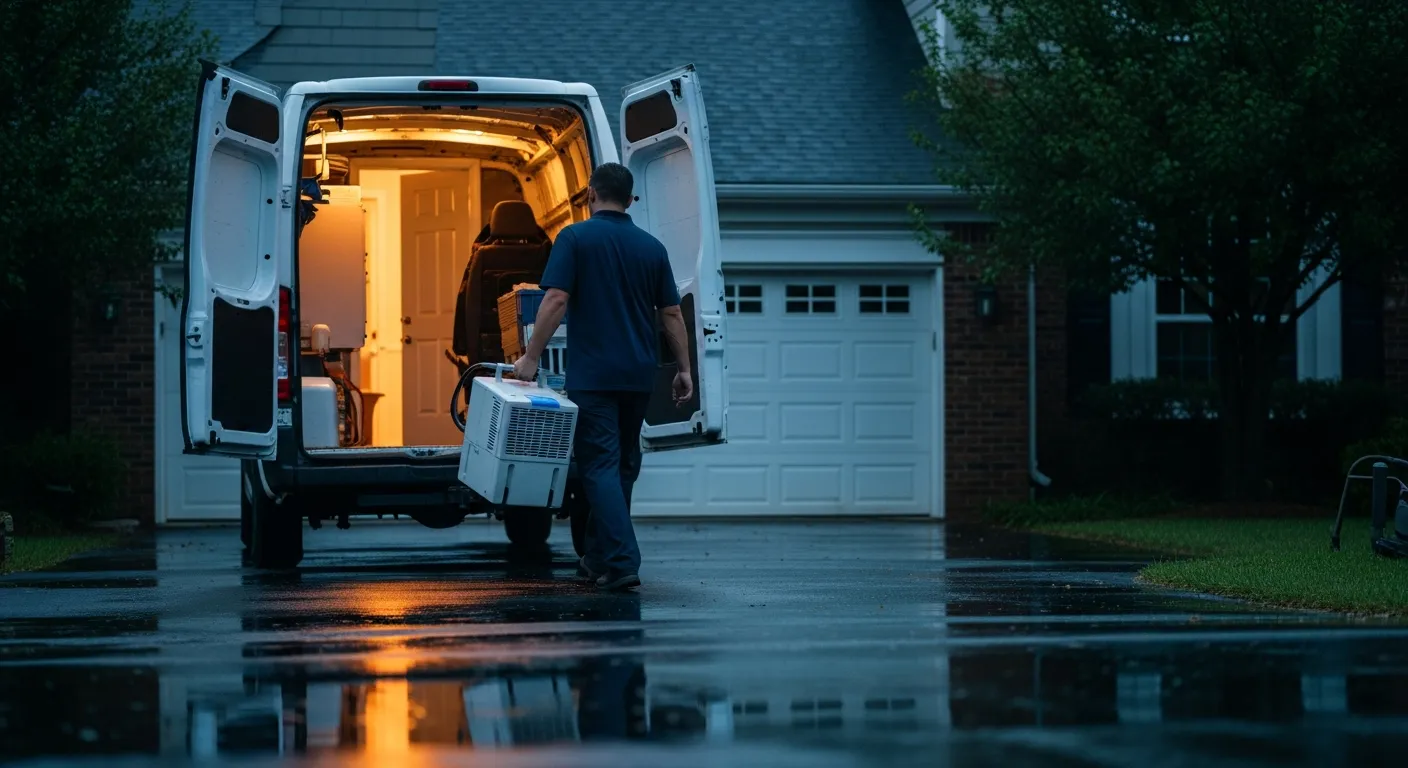
In restoration, the phone is the business
Water damage restoration runs on a clock that most trades never face. When a pipe bursts at 2 a.m. and water is spreading across a hardwood floor, the homeowner is not comparison-shopping — they are calling the first restoration company they can find, and then the next one, and the next, until someone answers and says "we're on the way." The company that picks up first, sounds competent, and commits to a response usually gets the job. The ones that go to voicemail lose it, permanently, in the time it takes the homeowner to dial the next number.
That single dynamic makes restoration the vertical where a missed call costs the most. A water-mitigation job — drying, demo, and the reconstruction that follows — routinely runs into five figures, and much of it is insurance-paid. As of July 2026, a restoration company that misses overnight and weekend calls isn't losing a $200 service ticket; it's handing a $10,000-plus job to a competitor who happened to answer. No other line item in the business has that leverage.
This guide covers the 24/7 answering and dispatch stack that ensures your company is the one that answers — every time, at every hour, even during a regional flood when the calls come all at once. It maps to the Run with Jarvis platform.
Layer 1: A 24/7 AI receptionist that never misses
The foundation is KeyBot, the AI phone agent, and for restoration its defining feature is simple: it never sleeps and it never rings out. It answers on the first ring — 2 p.m., 2 a.m., Christmas morning — in English or Spanish, captures the emergency details and the property address, triages or books the job, and sends an SMS confirmation.
This directly attacks restoration's core economics. The overnight and weekend calls that a human answering service handles by taking a message — and that an unstaffed office misses entirely — are exactly the high-value emergency jobs. An AI that answers instantly and starts the intake immediately puts you first in the race that decides who gets the job. Why that race is so decisive is laid out in the speed-to-lead guide, and the after-hours math is in the after-hours calls playbook.
Compared to a traditional answering service that just takes a message for a human to call back later, the difference is the whole ballgame. By the time the callback happens, the homeowner has already hired whoever answered live. AI vs. human answering service and answering service vs. AI receptionist walk through why "we'll have someone call you back" loses restoration jobs.
Layer 2: Parallel answering for regional events
Restoration demand is spiky in the most extreme way. A single burst-pipe cold snap or a flash flood can put an entire neighborhood underwater in the same night, generating dozens of emergency calls in a few hours. A human — or even a small overnight team — hits a busy signal wall almost immediately.
The AI answers calls in parallel. Forty simultaneous flood callers all get a real conversation and a triaged intake at the same moment. During a regional event, that's the difference between capturing the surge of your life and watching most of it dial competitors because your line was busy. The surge-capacity logic is in seasonal call volume management, and the safety net for anything that still slips is missed-call text-back.
Layer 3: Dispatch the nearest crew, fast
Answering the call is step one; getting a crew moving is step two, and in restoration the two are almost the same urgency. IntelliDrive provides GPS tracking and route optimization so you can dispatch the nearest available crew to the emergency and route them the fastest way there. Automatic ETA and arrival texts tell the anxious homeowner exactly when help arrives — which both reassures them and stops the flood of "how much longer?" calls during an event.
For a company running multiple crews across a metro, dispatching the closest truck instead of whoever happens to see the message shaves response time when minutes of standing water mean more demo and a bigger claim. The multi-crew dispatch mechanics are in CRM and dispatch software for multi-tech service businesses.
Layer 4: Documentation for the insurance claim
Restoration is an insurance business as much as a trades business, and insurance runs on documentation. The trouble with emergency intake is that the details — when the loss occurred, the affected areas, the homeowner's contact and policy information, the response timeline — historically live in a night-shift notebook, a voicemail, and someone's memory. When the claim gets built, half of it is missing.
IntelliDrive's CRM captures the job from the first call forward. The intake details, contact record, and job timeline are organized in one place from the moment the AI answers, so the paper trail the adjuster needs exists instead of being reconstructed after the fact. This isn't a legal-advice claim — it's operational hygiene: a clean, timestamped record from first contact makes the downstream claim smoother. The CRM foundation is covered in CRM and dispatch software.
The billing side matters too. IntelliDrive gives you POS, invoicing, and bidirectional QuickBooks sync, so mitigation invoices and payments stay aligned with your books without re-keying. See the QuickBooks sync guide. Payment links speed collection on the customer-responsible portions — get paid faster with payment links — and chargeback defense protects against disputes on card payments.
Layer 5: Reviews and reputation in a trust business
A homeowner in crisis hires the restoration company that looks trustworthy and well-reviewed. IntelliDrive automates review requests after a job closes, converting a well-handled emergency into the social proof that wins the next one. The playbook is in get more customer reviews.
On the Elite plan, that extends to AI-drafted review replies and Google Business Profile management — keeping your profile active and responsive, which matters enormously for a business people find in a panic via search.
Layer 6: Attribution for restoration ad spend
Restoration companies spend heavily on Google Ads and Local Services Ads to be visible at the moment of emergency. CallFlux, on the Pro plan, tells you which of that spend produced real jobs. It uses Dynamic Number Insertion and gclid attribution to tie each emergency call to its campaign and keyword, transcribes and records calls, and scores leads — so you can see which ads generate five-figure mitigation jobs versus tire-kickers. In a category with expensive clicks, that visibility is the difference between scaling a winning campaign and bleeding budget. Details in the call tracking and attribution guide.
Mapping the plans to restoration needs
Here's how the three Run with Jarvis tiers map to a water-damage restoration company. All plans include zero setup fees, unlimited users, and month-to-month terms.
| Plan | Price | Call minutes | Best for the restoration company that... | Key capabilities for restoration |
|---|---|---|---|---|
| Core | $500/mo | 500 min ($0.45/min overage) | Needs to never miss a 24/7 emergency call and run the whole operation | 24/7 AI receptionist EN/ES, emergency intake + booking, GPS crew dispatch, arrival texts, CRM documentation, POS + invoicing, QuickBooks sync, review automation, chargeback defense, AI outbound follow-up, mobile app |
| Pro ⭐ | $750/mo | 1,000 min ($0.40/min overage) | Runs Google Ads/LSAs and needs to know what converts | Everything in Core plus call tracking & attribution (DNI, gclid, transcription, lead scoring, recording) |
| Elite | $1,200/mo | 2,500 min ($0.35/min overage) | Wants to actively grow and automate marketing | Everything in Pro plus AI growth: campaign builder, Google Business Profile management, AI review replies, LSA lead management, and the Jarvis AI Assistant |
Given how much restoration companies spend to appear at the moment of emergency, most land on Pro — the attribution pays for itself by revealing which expensive clicks actually became jobs. Core runs the full 24/7 operation if you're not yet advertising heavily. The plan-selection guide helps you choose, and what AI operations actually cost compares it to staffing an overnight desk.
The overnight-desk math
The traditional way to catch overnight restoration calls is to pay for a live answering service or a night-shift dispatcher. Both are expensive, and both usually just take a message — the human dispatcher isn't quoting or committing a crew at 3 a.m., they're waking someone up. Meanwhile the homeowner has already hired the company whose AI answered live and said "a crew is on the way."
An AI receptionist changes the unit economics. Round-the-clock answering capacity that actually triages and dispatches — not just takes messages — comes at a flat monthly cost, no overnight payroll, no busy signals during a regional event. For a business where a single caught call can be a five-figure job, the return on that is not a close call. The broader argument for treating AI answering as an always-on employee is in what is an AI employee for service businesses.
Outbound follow-up: closing and confirming
Every plan includes AI outbound follow-up — not cold prospecting, but the calls that convert and confirm existing leads. That's following up on a mitigation estimate, confirming a scheduled reconstruction phase, or checking in on a lead that came in during a chaotic night and needs a callback to lock in. In restoration, where a job can involve mitigation now and reconstruction weeks later, automated follow-up keeps the pipeline moving. The mechanics are in AI outbound follow-up.
The metrics that tell you it's working
After the stack goes live, the numbers to watch are stark in restoration because the stakes per call are so high. Start with after-hours answer rate — the share of overnight, weekend, and holiday calls that actually get answered. This is the number that decides your business, and it should move to near-complete coverage since the AI never sleeps and never queues.
Track emergency jobs captured from off-hours calls against your baseline. Every one of these is potentially a five-figure mitigation job that a voicemail box used to lose, so even a small increase is outsized revenue. Pair it with speed to first response, which collapses to the first ring — the metric that determines who wins the panicked "water damage near me" search, per the speed-to-lead guide.
Watch documentation completeness on new jobs — with the CRM capturing intake from first contact, the share of jobs with a clean, timestamped record should rise, which smooths the downstream insurance claim. On billing, track days-to-payment on customer-responsible balances. On the Pro plan, watch cost per captured job by campaign so CallFlux attribution shows which expensive emergency ads actually produce mitigation work. And track review velocity, since reviews are what win the next crisis search. The full ROI framework is in the AI receptionist ROI guide.
Anatomy of a 2am flood call, start to finish
Trace the call that defines restoration economics. It's 2:10 a.m. A homeowner wakes to water spreading across the kitchen from a burst supply line under the sink. Panicked, they search "water damage near me" and start dialing.
Your AI answers on the first ring — no voicemail, no "our office hours are." It calmly captures what's happening: source of the water, affected rooms, roughly how long it's been going, the property address, and the homeowner's contact and insurance situation. It reassures the caller that help is being arranged and books or triages the emergency, then sends an SMS confirmation so the anxious homeowner has something concrete. That intake becomes a clean, timestamped record your on-call crew can act on immediately.
The competitor down the street, whose line rolled to voicemail, gets a message the homeowner never left — because by then the homeowner was already talking to you. That is the entire five-figure job, decided in the ninety seconds it took to answer versus not answer. The intake-and-booking logic is detailed in how AI appointment booking works, and why that ninety seconds decides the job is in the speed-to-lead guide.
What restoration owners ask before switching
"An answering service already takes my after-hours calls — why change?" Because a message-taking service just wakes someone up later. By then the homeowner has hired whoever answered live and committed a crew. An AI that answers, triages, and confirms in real time keeps you in the "we're on the way" position. The comparison is in answering service vs. AI receptionist.
"What if a regional flood floods my phone too?" That's the scenario the AI is built for — it answers in parallel, so a neighborhood-wide event produces dozens of simultaneous calls that all get answered instead of a busy signal. See seasonal call volume management.
"Will it help with the insurance side?" It organizes the job from first contact — details, timeline, contact record — in one CRM instead of a night-shift notebook. That's operational documentation, not legal advice, but a clean early record makes the downstream claim smoother. The CRM foundation is in CRM and dispatch software.
"Is 24/7 answering really cheaper than a night dispatcher?" For a business where one caught overnight call can be a five-figure job, the flat monthly cost of always-on answering — with no busy signals — is not a close call against overnight payroll. The full ROI framing is in the AI receptionist ROI guide.
The economics of never missing
It's worth sitting with the leverage restoration has that other trades don't. In most service businesses, a missed call is a lost ticket in the low hundreds. In restoration, a missed emergency call is routinely a lost job in the five figures, much of it insurance-paid, plus the reconstruction that often follows the mitigation.
Build an illustrative comparison from that structure. A restoration company that catches even a handful of additional overnight and weekend emergency jobs a month — jobs that would otherwise have gone to voicemail and then to a competitor — recovers many multiples of any plan's monthly cost from a single one. There is no other operational change with that ratio. It's why, of all the verticals, restoration is the one where "never miss a call" is not a slogan but the core financial strategy. The always-on-employee argument is in what is an AI employee for service businesses, and the after-hours specifics are in the after-hours calls playbook.
Building the stack in order
A practical rollout for a restoration company:
- Turn on 24/7 AI answering first. This is the single highest-return move in restoration — every overnight and weekend call it catches is a potential five-figure job. Get KeyBot answering EN/ES around the clock.
- Wire dispatch so the nearest crew gets routed to the emergency immediately.
- Use the CRM from the first call so insurance documentation is organized from contact zero.
- Connect QuickBooks and payment links so mitigation billing stays clean and collects fast.
- Automate reviews to build the reputation that wins the next panicked search.
- Add attribution (Pro) to see which emergency ads produce real jobs.
The value of one platform in restoration is speed: the AI that answers the flood call is the same system that dispatches the crew, documents the job for the claim, and invoices it — no hand-offs to slow you down at the exact moment speed decides who wins. If you're weighing that against separate tools, all-in-one vs. point solutions makes the case.
See the tiers against your own numbers at /pricing, or reach out to plan a 24/7 rollout before the next big storm.