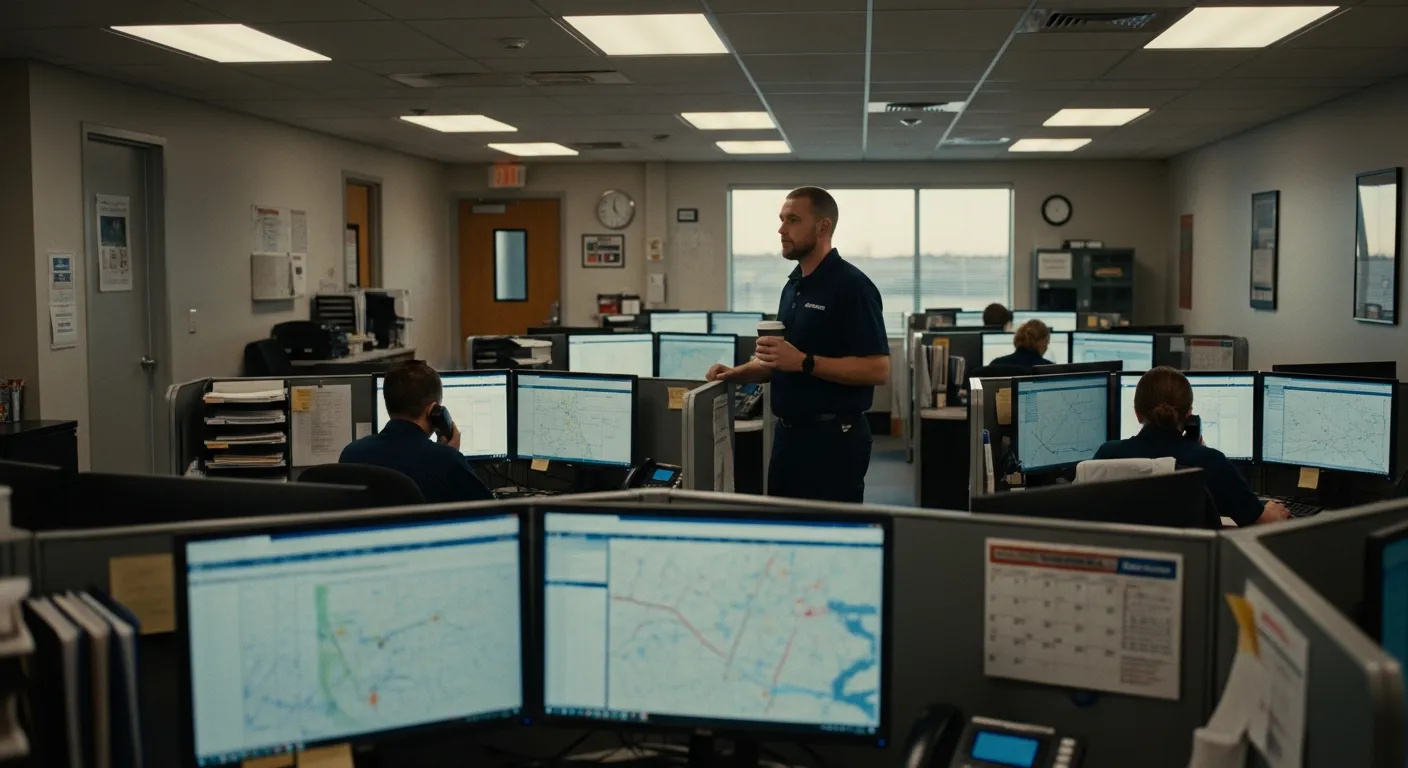
The busy season is where service businesses win or lose the year
Every service business lives on a curve. The roofer's phone erupts after a hailstorm. The HVAC company's summer is one long August. Pest control has termite swarm season; plumbers have the first hard freeze; landscapers have spring; retailers-adjacent trades have the holiday rush. For most trades, a disproportionate share of the entire year's revenue arrives in a handful of intense weeks.
That concentration is a gift and a threat at the same time. The gift is obvious — demand shows up ready to buy. The threat is quieter: your capacity to answer that demand is fixed, and the demand is not. When 200 calls land on a Tuesday during a storm and your front desk can handle 60, the other 140 don't wait politely. They call the next company on the list.
As of July 2026, the tools to solve this have changed, but most owners are still solving it the old way: by trying to predict the peak and staff up for it. This guide is about why that approach quietly loses money every year, and how AI call answering lets you absorb a spike at a flat, predictable cost instead of betting your margins on a hiring guess. The short version: seasonal staffing is a trap, and there's finally a way out of it.
The seasonal staffing trap
The instinct is reasonable. Volume is about to triple, so you add people to answer the phones. But the mechanics of hiring fight you at every step, and the mismatch is structural, not a matter of doing it better.
Hiring is slow; the peak is fast. A storm surge arrives in hours. A seasonal hire takes weeks to recruit, interview, onboard, and train to the point where they can quote accurately and book without mistakes. By the time your new person is competent, the peak that justified them is often winding down. You paid full ramp cost for partial peak coverage.
Fixed labor, variable demand. This is the core problem. A salary is a flat monthly cost. Demand is a spike. When you staff for the peak, you carry that payroll through the trough — the slow weeks before and after, and the dead off-season. When you staff for the average, you get crushed at the peak. There is no headcount number that matches a curve, because a person is a constant and the curve is not.
Training debt compounds. Seasonal staff are, by definition, new. They quote wrong, book the wrong slot, mishandle the anxious caller, forget to collect the address. Every one of those errors is a lost or damaged job during the exact window when jobs are most valuable. And you're supervising them instead of running the business.
They leave, and the knowledge leaves with them. You invest weeks getting someone useful, then the season ends and they're gone. Next peak, you start over from zero with a new hire and the same ramp. You never accumulate the capacity you paid to build.
Over-hiring and under-hiring both cost money — you just can't see one of them. Over-hire and the cost is visible: idle payroll on the books. Under-hire and the cost is invisible: dropped calls that never became jobs, leaving no trace on your ledger. Most owners fear the visible cost and quietly eat the invisible one, which is usually the larger of the two. We wrote about that hidden leak in the missed-call text-back guide — a dropped call leaves no record, so you never know the revenue you lost.
Put it together and the seasonal staffing decision is a no-win: pay for capacity you don't use most of the year, or lose the jobs that make your year. The trap isn't that owners staff badly. It's that a fixed resource cannot cover a variable spike, no matter how well you plan it.
Where the calls actually go when you can't answer
A dropped call at peak isn't a neutral event you recover later. It's a job booked by a competitor, in real time, while your line rings out.
Peak-season callers are the highest-intent callers you will ever get. A homeowner with no AC in a heat wave, a business with a burst pipe, a family locked out on a holiday — these people are not shopping. They have an urgent problem and an open list of numbers, and they are dialing down that list until someone picks up. The moment a human voice answers with confidence and a plan, they stop dialing. Everyone after that on their list loses.
This is why peak season punishes slow response so much harder than a normal week. In a slow week, a missed call might leave a voicemail and call back tomorrow. In a storm, there is no tomorrow — there are twelve other companies whose phones are also ringing, and the caller will be booked within the hour. Speed to lead, which matters year-round, becomes the entire game during a surge. Our speed-to-lead guide covers the response-time economics in full; at peak, every one of those effects is amplified.
And the failure compounds. When your team is underwater, they don't just miss calls — the calls they do answer get worse. Rushed quotes, hold times, curt conversations, forgotten follow-ups. The peak that should be your best revenue window becomes your worst customer-experience window, and the reviews that follow drag on the next season too. A surge you can't absorb damages more than the day it happens.
The math of a spike
Let's make the capacity gap concrete with simple, illustrative numbers — plug in your own.
Say a normal week brings 50 calls, comfortably handled by your existing front desk. A storm hits and the following week brings 250 — five times normal. Your team's capacity didn't change; it's still about 50 well-handled calls plus some overflow. So roughly 180 to 200 calls that week land in voicemail, on hold, or ringing out.
Now suppose your average job is worth $400 and a healthy share of promptly answered peak callers book. Every unanswered call in that surge week is a coin flip you declined to enter — and it's a coin flip you'd usually win, because the caller is high-intent and ready. Even at a conservative booking rate, 180 dropped high-intent calls is a very large number of jobs handed to competitors in a single week.
Here's the part that stings: that surge week might represent a meaningful fraction of your entire year's opportunity. Losing most of it isn't losing a slow Tuesday. It's losing the season. And you can't hire your way out fast enough, because the storm is over before the new person is trained.
The exact figures are yours to fill in — your normal volume, your surge multiple, your average ticket, your close rate. But the structure is universal: at peak, your fixed capacity becomes a hard ceiling, and everything above that ceiling is revenue you can see coming and still can't catch. For a full worked model of what answered-vs-missed calls are worth, see our AI receptionist ROI guide.
Why AI answering breaks the trap
The reason AI answering solves seasonal volume is not that it's cheaper labor. It's that it removes the ceiling entirely. A human phone team has a hard concurrency limit — one person, one conversation. AI answering has no such limit, and that single difference changes the whole equation.
KeyBot, the call-answering layer of Run with Jarvis, answers every inbound call on the first ring, 24/7, in English and Spanish. It doesn't just pick up — it runs the whole conversation. It understands the caller's problem, quotes pricing, checks live availability through GetTimePad, books the appointment, and sends an SMS confirmation before the caller hangs up. On a normal Tuesday it handles your 50 calls. During a storm it handles 250 the same way, at the same quality, with no hold queue and no drop-off, because it answers them in parallel rather than one at a time.
That's the whole unlock. The thing that makes a human team buckle under a surge — everyone talking to one caller while nine others wait — simply doesn't apply. Ten simultaneous storm calls are ten simultaneous conversations, each answered, quoted, and booked. The peak stops being a capacity crisis and becomes what it should always have been: a revenue event.
And it scales down just as cleanly. In the off-season, when your volume falls, you're not carrying idle phone staff. Usage is metered by the minute, so a quiet February costs less than a frantic July. Your answering capacity tracks demand instead of fighting it — the exact opposite of a seasonal salary, which costs the same whether the phone rings or not.
There's a consistency benefit too. A stressed human team gets worse under load; the quotes and the manners both degrade. AI answering delivers the same complete, accurate conversation on call 5 and call 205. The caller during your worst hour gets the same experience as the caller during your calmest — which protects the reviews that carry into next season.
The cost model: flat and metered, not fixed headcount
Here's where the economics flip decisively. Seasonal staffing forces you to buy capacity in the shape of a person — a whole salary, whether or not the phone rings. AI answering lets you buy capacity in the shape of demand — metered minutes that rise during the spike and fall in the trough.
Run with Jarvis is priced month-to-month with no setup fees, no per-user charges, and no annual lock-in. Each plan includes a block of AI call minutes with a clear per-minute overage rate when you exceed it during a busy stretch:
| Plan | Monthly price | Included AI minutes | Overage rate | Best fit |
|---|---|---|---|---|
| Core | $500/mo | 500 min | $0.45/min | Steady demand with occasional spikes; full operations stack |
| Pro | $750/mo | 1,000 min | $0.40/min | Pronounced seasonal swings plus call tracking and ad attribution |
| Elite | $1,200/mo | 2,500 min | $0.35/min | Heavy seasonal volume plus AI growth and campaign tools |
The point of the table isn't which row to pick — it's the shape of the cost. During a spike, you don't hire; you consume more metered minutes at a known rate. If a 4-minute average call is typical, Core's 500 minutes is roughly 125 calls a month before any overage, and every call beyond that is a predictable $0.45 — not a $3,000 seasonal salary you committed to in advance and hope you use. The cost moves with the curve.
That predictability is the whole argument. A seasonal hire is a bet: you commit to fixed cost hoping demand shows up to justify it. Metered minutes are the opposite of a bet — you pay for exactly the volume you actually get, more in the peak, less in the trough, with the plan price as your stable floor. For a broader breakdown of what AI operations actually cost versus the alternatives, see what AI operations actually cost in 2026.
AI first, humans where they matter
None of this means fire your team. It means stop using expensive, hard-to-scale human capacity for the one job that scales worst under load: answering a ringing phone during a surge.
The right structure at peak is a division of labor. AI answering takes the front line — every call, every time, quoting and booking the routine majority without a queue. Your humans move to where their judgment actually earns its cost: the field work, the complex or high-value job that needs a real conversation, the escalation the AI hands off cleanly. Instead of a stressed front desk triaging 250 calls badly, you have AI handling 250 calls completely and your people focused on the work only people can do.
That's a better use of your existing staff even before you count the savings. Your best dispatcher spending peak week as a switchboard operator is a waste of your best dispatcher. Let the AI switchboard the surge and put that person on the exceptions and the field coordination. The AI-vs-human answering comparison walks through where each genuinely wins — the answer is almost always both, with the line drawn at "does this need human judgment or just a fast, accurate response?"
And the handoff matters. When a call does need a person, it should reach one warm, not dumped to voicemail. Every plan includes SMS and missed-call handling, so an edge case that needs human follow-up is captured and routed rather than lost. The AI isn't a wall in front of your team; it's a filter that lets your team spend the peak on the calls that are worth their time.
Building a seasonal-ready operation
Handling the surge is more than answering the phone. It's carrying that answered call through booking, dispatch, and follow-up without the spike breaking any link in the chain. A few pieces make an operation genuinely seasonal-ready.
- Answering with no ceiling. The foundation: every call answered live, in parallel, at peak or trough. This is what removes the capacity gap. Everything else depends on it, because a call you never answered can't be booked, dispatched, or followed up.
- Live booking, not a callback promise. During a surge, "we'll call you back to schedule" is where leads die — there's no time for a second touch. Booking the job live on the first call, against real calendar availability, is what converts peak intent before it evaporates. See how AI appointment booking works.
- Dispatch and routing that keep up. More booked jobs means more trucks to route. GPS tracking and route optimization through IntelliDrive keep a swollen schedule from turning into missed arrival windows, and automatic ETA and arrival texts keep customers informed when your team is slammed. CRM and dispatch for multi-tech operations covers this layer.
- Reminders that protect the booked jobs. A peak schedule packed with appointments is worthless if a chunk no-show. Automated reminders keep the surge of bookings from leaking back out. See reducing no-shows with appointment reminders.
- Attribution so you know which spikes to plan for. If you run ads into your busy season, you need to know which calls came from where. Call tracking and ad attribution — included from the Pro plan up — tell you which channels drive your surge, so next season you invest into what actually works. See call tracking and attribution.
The thread through all of it: a spike doesn't break one thing, it stress-tests everything. An operation that answers every call but can't route the trucks, or books every job but can't stop the no-shows, still leaks at peak. The value of a single connected stack is that the whole chain scales together — which is the broader case we make in all-in-one versus point solutions.
Common objections, answered
A few hesitations come up whenever an owner considers replacing seasonal hiring with AI answering. Most dissolve on inspection.
"My peak callers are stressed — they need a real person." They need a fast, competent response, which is exactly what silence and voicemail fail to give a stressed caller. An AI that answers on the first ring, understands the emergency, quotes, and books is far more "real" to a panicked customer than a ringing phone or a callback promise. And the genuinely complex calls still route to your team — now unburdened by the routine 80%.
"What if the AI can't handle an unusual request?" Then it hands off. The design isn't AI-or-nothing; it's AI for the routine majority and a clean escalation for the exception. During a surge, that split is precisely what you want: the flood of standard calls handled automatically, your people free for the handful that truly need them.
"I'd rather keep the money in-house with a hire." A seasonal hire isn't money in-house — it's fixed cost you commit to before you know the demand, plus recruiting time, training time, supervision, and idle payroll on either side of the peak. Metered minutes are money spent only on volume you actually received. One is a bet; the other is a bill that matches the work.
"My season is unpredictable — I can't plan for it." That's the strongest argument for AI, not against it. Unpredictability is exactly what fixed staffing can't handle: you can't hire in time for a surprise storm, and you can't un-hire when it doesn't come. Capacity that scales instantly and costs by the minute is the only thing that matches a peak you can't forecast.
The common thread: the objections assume AI answering is a downgrade you tolerate to save money. In a surge it's an upgrade — more calls answered, answered faster, answered consistently, at a cost that tracks the demand instead of gambling against it.
Putting it together
Seasonal call volume forces a choice that has no good answer under the old model. Over-hire and you carry idle payroll through the off-season. Under-hire and you drop the high-intent calls that make your year. Predict the peak perfectly and you still can't hire fast enough to catch a storm that arrives in hours. The fixed-labor-versus-variable-demand mismatch is unwinnable by staffing alone.
AI answering breaks the trap by removing the ceiling. It answers every call in parallel, at peak or trough, quotes and books live, and costs metered minutes that rise with the spike and fall with the lull. Your humans stop being a switchboard and go back to the field work and judgment calls that actually need them. The peak stops being a crisis you brace for and becomes a revenue event you're built to absorb.
The businesses that win their busy season aren't the ones who guessed the hiring number right. They're the ones who stopped guessing — who put capacity that scales instantly in front of the phone and reserved their people for the work only people can do. See transparent, month-to-month pricing or get in touch to watch KeyBot answer, quote, and book a surge of calls the way your busiest week actually needs.