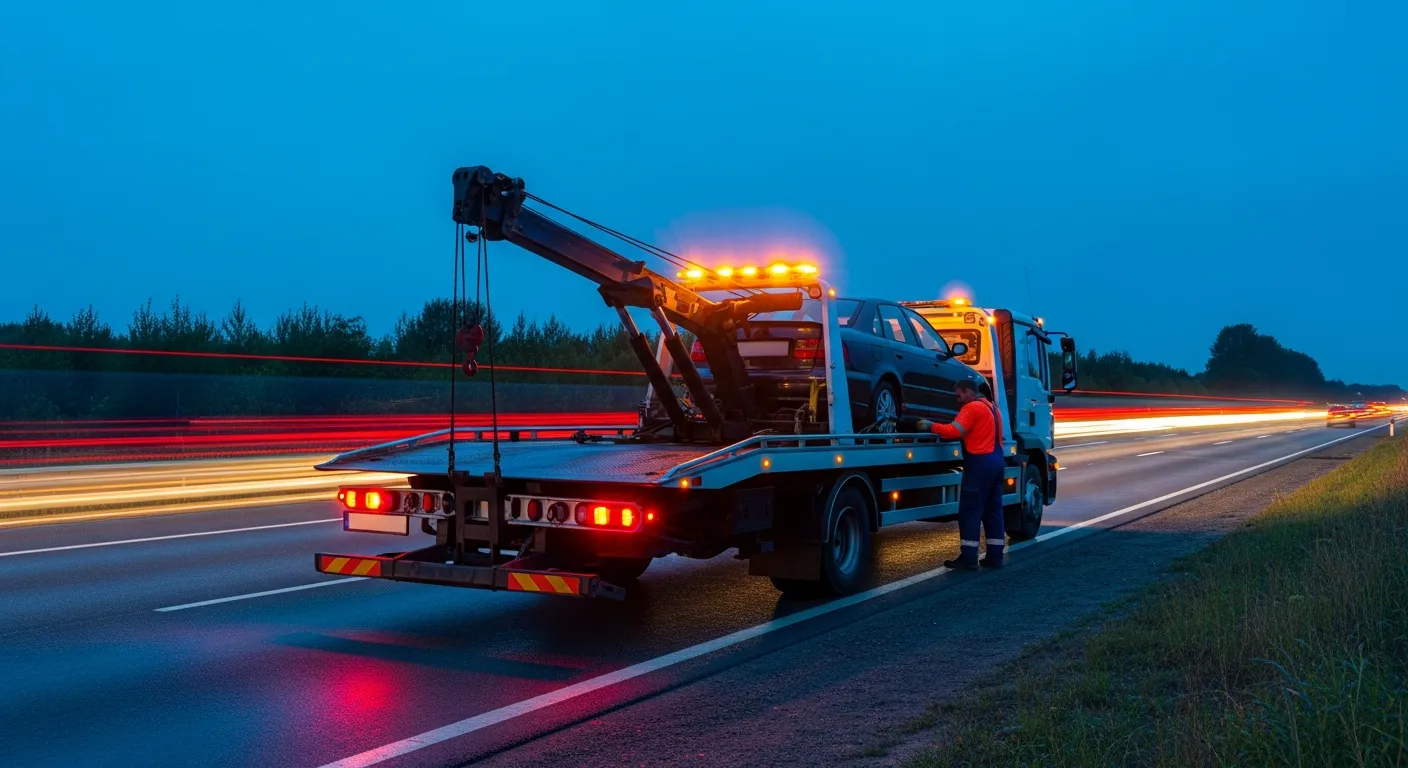
A towing company is only as good as its answered calls
Towing is the purest first-to-answer business there is. A driver stranded on a highway shoulder, engine dead, traffic flying past, is not shopping for the best price or reading reviews — they are calling tow companies one after another until a human voice says "we've got a truck on the way." Whoever answers first gets the job. Everyone who went to voicemail or gave a busy signal gets nothing.
That makes answering capacity the entire business. A towing operation can have the best trucks and the fastest drivers in the region, but if the dispatch phone is already on another call — or nobody's manning it at 3 a.m. — the stranded driver is already talking to a competitor. As of July 2026, the towing companies that grow are the ones whose phone is answered instantly, at every hour, no matter how many people are calling at once.
This guide covers the AI answering and dispatch stack for a towing company: 24/7 parallel answering, capturing the caller's location, dispatching the nearest driver by GPS, handling motor-club and cash calls, and doing it all in English and Spanish. It maps to the Run with Jarvis platform.
Layer 1: 24/7 parallel answering that never gives a busy signal
The core of the towing stack is KeyBot, the AI phone agent. It answers on the first ring, 24 hours a day, in English or Spanish. For towing, two properties matter above all else.
It's always on. Towing demand is heaviest exactly when offices are closed — nights, weekends, holidays, bad weather. An AI that answers instantly at 3 a.m. captures the stranded-driver calls that a voicemail box loses. The after-hours economics are in the after-hours calls playbook, and the reason answering speed decides who wins is in the speed-to-lead guide.
It answers in parallel. Towing demand spikes violently — a multi-car pileup, an ice storm, a fuel-price weekend that strands dozens of drivers all at once. A human dispatcher can hold one call; the rest get a busy signal, which in towing is a lost job every time. The AI handles many simultaneous callers, so the whole spike gets answered and dispatched. That surge capacity is covered in seasonal call volume management, and the net for any call that still slips is missed-call text-back.
The bilingual capability is not optional for a stranded-driver business serving a diverse population at all hours. The AI handles the entire tow call — location, vehicle, dispatch — in Spanish when the caller prefers it. See bilingual Spanish answering. And if you're comparing this to a live call-center answering service, AI vs. human answering service explains why an agent that actually dispatches beats one that just takes a message.
Layer 2: Capturing the caller's location — the make-or-break of a tow call
Every tow call comes down to one question: where is the vehicle? A tow that can't be located is a tow that can't be sent. The AI's job on a towing call is to nail down exactly where the stranded vehicle is — the highway and direction, the mile marker or cross street, the parking structure and level — along with what the vehicle is and what's wrong with it (won't start, flat, accident, locked out).
Getting that intake right on the first call is what makes the dispatch fast and accurate. A vague location means a driver circling an interchange looking for a car; a precise one means the truck goes straight there. The AI structures that intake consistently on every call, then hands a clean, dispatchable record to your team. The booking-and-intake mechanics are in how AI appointment booking works — for towing, "booking" is capturing the job and its location.
Layer 3: GPS dispatch of the nearest driver
Once the location is captured, speed of dispatch is the next lever. IntelliDrive tracks your trucks by GPS, so you can send the nearest available driver to the caller instead of whoever happens to grab the job. Route optimization gets that driver there by the fastest path, and automatic ETA and arrival texts tell the stranded customer exactly when the truck arrives.
Those arrival texts matter more in towing than almost anywhere. A driver alone on a dark shoulder, anxious and exposed, is calling back every few minutes to ask where the truck is — unless they've already got a text with an ETA. Deflecting those status calls keeps your line open for new stranded-driver calls, and reassuring the customer keeps them from calling a second company while they wait. The multi-truck dispatch mechanics are in CRM and dispatch software for multi-tech service businesses.
Layer 4: Motor-club and cash calls, one clean record
Towing revenue comes through two very different doors: motor-club and insurance dispatches on one side, direct cash and card jobs on the other. Both need to land in one system so you're not running the business out of two notebooks. IntelliDrive gives you CRM, POS, and invoicing in one place, so every job — club or cash — is a record you can dispatch, bill, and track.
For the cash and card side, the POS and payment links let a driver collect on the spot or send a link the customer pays from their phone. See get paid faster with payment links. Bidirectional QuickBooks sync keeps the books aligned without re-keying — the QuickBooks sync guide — and chargeback defense protects against disputes on card payments, which happen in a business where the customer was stressed and the transaction was fast.
Layer 5: Reviews to win the searchable jobs
Not every tow is an emergency dial-the-first-number job. Scheduled tows, equipment moves, and the "who should I call next time" decision all run on reputation and search visibility. IntelliDrive automates review requests after a job, turning a smooth tow into the reviews that win the next searchable customer. The playbook is in get more customer reviews.
On the Elite plan, that extends to AI-drafted review replies and Google Business Profile management, keeping the profile active for a business people find via a panicked "tow truck near me" search.
Layer 6: Attribution for towing ad spend
Towing companies bid on expensive "tow truck near me" keywords and run Local Services Ads. CallFlux, on the Pro plan, tells you which of that spend produced real tows. It uses Dynamic Number Insertion and gclid attribution to tie each call to its campaign and keyword, records and transcribes calls, and scores leads — so you know which ads generate paying jobs versus price-shoppers and wrong numbers. In a category with high click costs, that clarity is the difference between scaling and bleeding budget. Details in the call tracking and attribution guide.
Mapping the plans to towing needs
Here's how the three Run with Jarvis tiers map to a towing operation. All plans include zero setup fees, unlimited users, and month-to-month terms.
| Plan | Price | Call minutes | Best for the towing company that... | Key capabilities for towing |
|---|---|---|---|---|
| Core | $500/mo | 500 min ($0.45/min overage) | Needs 24/7 answering, location capture, and dispatch for the whole operation | 24/7 AI receptionist EN/ES, location + vehicle intake, GPS driver dispatch, arrival texts, CRM, POS + invoicing, QuickBooks sync, review automation, chargeback defense, AI outbound follow-up, mobile app |
| Pro ⭐ | $750/mo | 1,000 min ($0.40/min overage) | Bids on "tow near me" ads and wants to know what converts | Everything in Core plus call tracking & attribution (DNI, gclid, transcription, lead scoring, recording) |
| Elite | $1,200/mo | 2,500 min ($0.35/min overage) | Wants to actively grow and automate marketing | Everything in Pro plus AI growth: campaign builder, Google Business Profile management, AI review replies, LSA lead management, and the Jarvis AI Assistant |
High-volume towing companies often blow past 500 minutes given how many calls a day the business takes, so the higher minute allotments on Pro and Elite frequently matter as much as the added features. The plan-selection guide helps you match minutes to your call volume, and what AI operations actually cost compares it to staffing a 24/7 dispatch desk.
The 24/7 dispatch-desk math
The old way to answer towing calls around the clock is to pay dispatchers for night and weekend shifts. It's expensive, it's hard to staff, and a single human still gives a busy signal the moment a second call comes in during a spike. The stranded driver who got the busy signal is gone.
An AI receptionist changes the math. It's always on, it never gives a busy signal because it answers in parallel, and it costs a flat monthly rate instead of round-the-clock payroll. For a business where every answered call is a potential job and every busy signal is a lost one, always-on parallel answering is the highest-leverage investment on the board. The broader case for AI answering as a 24/7 employee is in what is an AI employee for service businesses, and the growth-without-headcount angle is in scaling without hiring.
Outbound follow-up: confirmations and callbacks
Every plan includes AI outbound follow-up — not cold sales, but the calls that support existing jobs. That's confirming a scheduled tow or equipment move, following up on a quote for a non-emergency job, or calling back a lead that came in during a chaotic surge. For a towing company, automated follow-up keeps scheduled work locked in and non-emergency quotes from going cold. The mechanics are in AI outbound follow-up.
The metrics that tell you it's working
Once the stack is live, the numbers to watch are unusually clean in towing because the connection between answered calls and revenue is so direct. Start with answer rate, and specifically the busy-signal rate during peak hours — the share of overlapping calls that used to get a busy signal. Because the AI answers in parallel, the busy-signal rate should go to zero, and that alone recovers jobs that were leaking to competitors in real time.
Track after-hours jobs captured against your baseline. Towing demand peaks when offices are closed, so the overnight and weekend calls the AI now answers are pure recovered revenue a voicemail box was dropping. Pair it with average dispatch time — the gap between the call landing and a truck being routed — which tighter location capture and GPS dispatch should shorten, and shorter dispatch means more jobs per truck per shift.
Watch location-capture accuracy, measured practically by how often a driver has to call the customer back to find them; a good intake drives this down. On billing, track collection rate on cash and card jobs, which POS and payment links should improve. On the Pro plan, watch cost per paying job by campaign so CallFlux attribution shows which "tow near me" keywords actually produce tows. The full ROI framework is in the AI receptionist ROI guide.
Anatomy of a stranded-driver call, start to finish
Trace the call that is your entire business. It's 11:40 p.m. A driver's car died on the shoulder of a busy interstate, traffic roaring past, and they're calling tow companies down the list until someone answers.
Your AI answers on the first ring. It stays calm and gets straight to what dispatch needs: which interstate and direction, the nearest mile marker or exit, what the vehicle is, and what's wrong — dead battery, accident, flat, lockout. It confirms the callback number and captures whether this is a cash job or a motor-club dispatch. That structured, dispatchable record goes to your team, and the nearest truck gets routed straight to the vehicle with an arrival ETA texted to the driver.
The tow companies the driver dialed before you — the ones whose lines went to voicemail or gave a busy signal — never had a chance. In towing, the whole job is decided at "someone answered," and the quality of the location capture decides how fast your truck actually finds the car. The intake logic is in how AI appointment booking works; for towing, the "booking" is the dispatchable job record.
What towing owners ask before switching
"My dispatchers know the roads — can an AI really capture location?" Its job on every call is to pin down exactly where the vehicle is and structure that consistently, so your team or your nearest driver gets a clean location instead of a vague one scribbled during a busy night. It's built to nail the one field that makes or breaks a tow.
"What about busy signals during a pileup?" That's the core reason to switch. A human dispatcher can hold one call; the AI answers in parallel, so a pileup or ice storm that strands a dozen drivers at once gets a dozen calls answered and dispatched instead of eleven busy signals. See seasonal call volume management.
"Can it handle both motor-club and cash calls?" Yes — both flow into one CRM and POS, so club dispatches and direct cash or card jobs live in the same system you dispatch and bill from. Payment links and QuickBooks sync keep the cash side clean; see the QuickBooks sync guide.
"Will it lose me the Spanish-speaking callers I get now?" The opposite — it handles the entire tow call in Spanish, which for a 24/7 stranded-driver business is a meaningful share of calls a single English-only dispatcher would fumble. See bilingual Spanish answering.
Why parallel answering is the whole game in towing
Every trade benefits from answering more calls, but towing is unique in that a busy signal is an instant, total loss. There's no callback economy in towing — the stranded driver isn't leaving a voicemail and waiting, they're already dialing the next company before your line even finishes ringing. Whatever fraction of your calls hit a busy signal or voicemail is a fraction of your revenue that goes directly to competitors, in real time, every night.
Build the illustrative math from that. A towing company whose single dispatcher gives a busy signal to even a modest share of overlapping calls during peak hours is handing away that exact share of jobs — not deferring them, losing them. Parallel answering closes that leak completely: no caller ever hears a busy signal, because there's no queue. For a business this dependent on being the one who answers, that alone can reshape the revenue line, before you even count the after-hours calls a voicemail box was silently dropping. The always-on-employee case is in what is an AI employee for service businesses, and the ROI framing is in the AI receptionist ROI guide.
Building the stack in order
A practical rollout for a towing company:
- Turn on 24/7 parallel AI answering first. This ends busy signals and voicemail misses — the two things that cost a towing company the most. Get KeyBot answering EN/ES around the clock.
- Tighten location intake so every dispatch goes straight to the vehicle.
- Wire GPS dispatch and arrival texts so the nearest truck gets sent and the customer stays reassured.
- Run club and cash jobs through one CRM/POS with QuickBooks sync so billing stays clean.
- Automate reviews to win the searchable and scheduled work.
- Add attribution (Pro) to see which "tow near me" ads produce paying jobs.
The strength of one platform in towing is speed and completeness: the AI that answers the stranded-driver call is the same system that captures the location, dispatches the nearest truck, and bills the job — no hand-offs at the moment speed decides who gets the tow. Compared to bolting together separate tools, all-in-one vs. point solutions makes the case for one stack.
See the tiers against your own call volume at /pricing, or get in touch to plan a 24/7 answering-and-dispatch rollout.