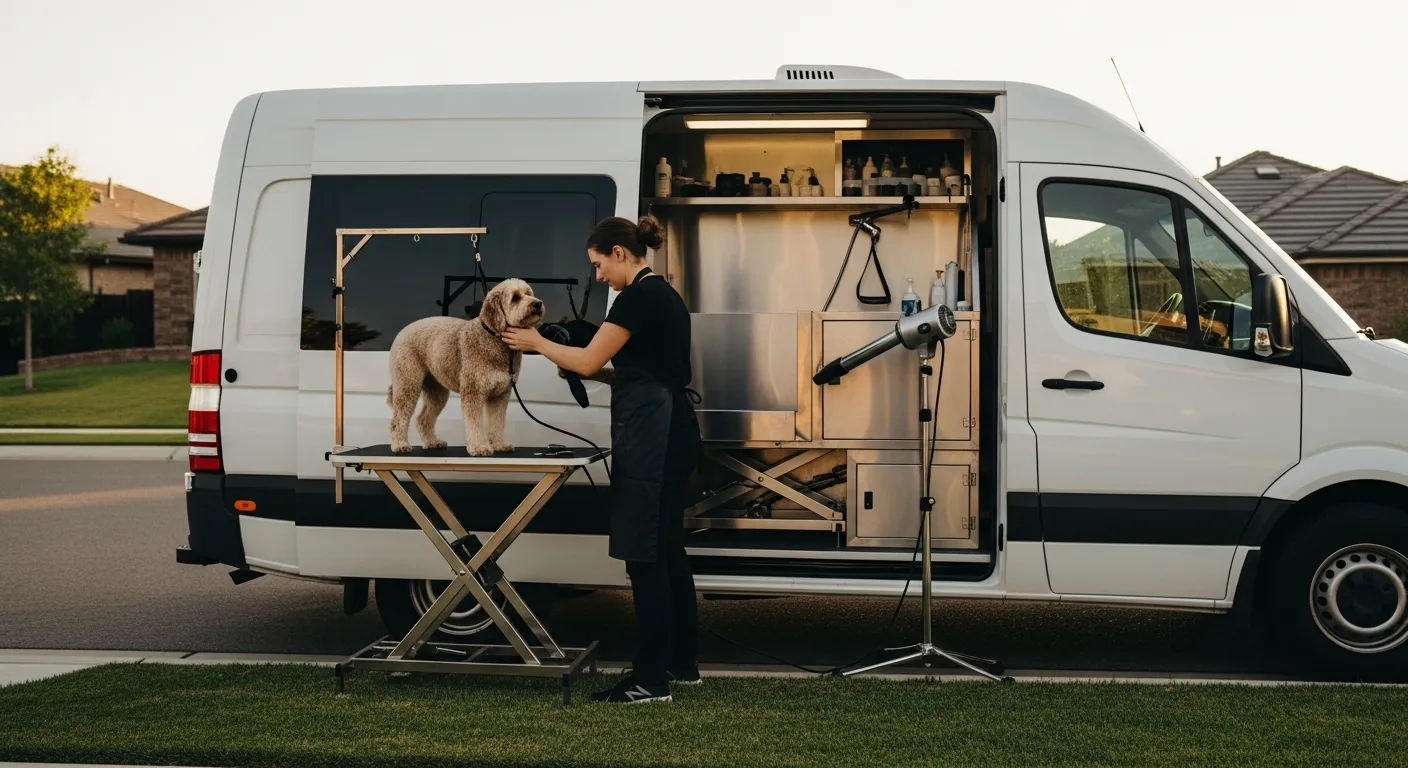
A mobile groomer does not sell grooming, they sell blocks
A shop groomer with four tables can absorb a mistake. Somebody cancels, the next dog moves up, a bather picks up slack, and the day rebalances. A mobile groomer sells a fixed and very small number of appointment blocks per day, and there is no bench. Most single-van operations run five to seven dogs, each occupying roughly ninety minutes on the table plus fifteen to thirty minutes of drive on either side. That is the entire inventory. It does not restock, it does not carry over, and by 8:15 in the morning the day's revenue ceiling is already set.
Which is why the economics of this trade are so unforgiving in one specific direction: every lost block is lost permanently. A cancellation at 7 AM for a 10 AM appointment cannot be refilled, because the replacement client would need to already be free, already be on the route, and already be prepped. A no-show is worse — you burned the drive too. And a call that went to voicemail at 11 AM while you were holding a wet Goldendoodle is a client who called the next groomer on the list ten minutes later.
As of August 2026, the operations that have gotten past the one-van ceiling generally did three unglamorous things: they took the phone out of the van, they turned breed and coat into a scripted intake that produces a real price, and they stopped letting clients leave without the next appointment on the calendar. This guide walks the full stack — answering, quoting, screening, duration modeling, routing, cycle management, cancellation economics, upsells, and seasonality — mapped to the Run with Jarvis platform.
Why mobile grooming loses calls in a very particular pattern
The work is hands-wet, hands-full, and cannot be interrupted. A groomer with clippers near a dog's face, or holding a nervous dog on a raised table, cannot answer a phone. Unlike a trade where someone can wipe their hands and step outside, walking away mid-groom is a safety issue for the animal. So the phone rings against an operator who is structurally unable to answer it for most of the working day.
The caller is impulsive and comparison-shopping. Nobody has a grooming emergency, but a matted dog, a shedding season, or an upcoming trip creates a short window of motivation. That caller has three groomers pulled up on their phone. The decay is exactly the pattern described in the speed-to-lead guide: a callback at 6 PM often reaches someone who already booked at noon.
The tickets look small and are not. A single groom might be 85 to 150 dollars depending on market and dog. That feels losable right up until you notice the client behind it had a six-week cycle, which is eight or nine appointments a year, plus a second dog, plus referrals to two neighbors on the same street. A lost first-time caller is rarely a lost hundred dollars. It is a lost recurring route stop.
Booking questions are long, and repeated all day. Breed, mix, weight, coat, last groom date, matting, temperament, vaccination, address access, power and water, parking, gate, other pets, medical notes. Fifteen fields, thirty times a week. A human running that interview at 4 PM after five dogs starts trimming questions, and the trimmed question is always the one that turns a ninety-minute appointment into a three-hour disaster.
Layer 1: An AI receptionist that answers while your hands are on a dog
The foundation is KeyBot, the AI phone agent. It answers on the first ring in English or Spanish at any hour, runs your grooming intake in full, quotes from your own price rules where quoting is safe, books into real van availability, and texts a confirmation with the deposit terms.
Parallel answering matters more here than in almost any other trade, because the groomer is unavailable in long uninterruptible stretches rather than in short gaps. Calls do not arrive politely spaced. A Monday morning after a weekend of ignored voicemail produces six calls in forty minutes, and a single person answering one at a time loses five of them. The AI holds all six at once and every caller leaves with a price and a slot.
The second property is that it never shortens the interview. A grooming intake done identically on call three hundred as on call one is the difference between an accurate schedule and a schedule built on optimistic guesses. Consistency is not a nice-to-have in a business where a single bad duration estimate cascades through every remaining stop of the day.
A message-taking answering service solves the wrong half of this. It hands you a name and a callback number without breed, coat, matting or address access — meaning you still have to make the call you were trying to avoid, and you make it after the client already booked elsewhere. A phone menu is worse: an impulse caller with a matted dog does not press three.
Layer 2: Quoting by breed, coat, size, and condition
Grooming pricing is more formulaic than groomers usually admit. It resolves to five inputs.
Breed or breed mix. Most shops already run a per-breed rate card, because breed is a proxy for coat type, standard cut complexity, and time on the table. A Shih Tzu, a Standard Poodle, a Husky and a Labrador are four completely different labor profiles. For mixes, the intake should ask what the dog most resembles and what the coat actually does, since a doodle mix can be anywhere from a wash-and-tidy to a two-hour de-mat.
Weight or size band. Under 20 pounds, 20 to 50, 50 to 80, over 80. Size drives handling difficulty, tub time, dry time, and whether the job needs a second set of hands. Large-breed grooming should never share a price band with small dogs no matter how simple the cut is, because drying a giant double coat alone can eat forty-five minutes.
Coat type and condition. Double coat, curly, wire, silk, short and smooth. Coat type sets the dry and de-shed time, which is usually the longest single phase of the groom.
Time since the last groom. This is the highest-signal question in the entire intake and the one most often skipped. A dog groomed eight weeks ago is a maintenance appointment. A dog last groomed in November is a different job entirely, and pretending otherwise is how a ninety-minute block becomes a two-and-a-half-hour block that destroys the three stops behind it.
Requested service. Full groom, bath and tidy, de-shed, puppy first groom, nails only, sanitary trim. Each has a real duration and a real price.
Two guardrails on automated quoting:
Quote only where quoting is safe. Severe matting, aggression or bite history, senior dogs with mobility or cardiac issues, and any dog the client describes as "difficult with the last groomer" should route to a human callback rather than an automated number. Those are not price questions, they are accept-or-decline questions.
Capture the inputs even when you do not quote. If the call ends in a callback, the groomer should be dialing back with the full picture already recorded, not starting the interview over. The mechanics of pulling a real number off your own rate card are covered in how an AI receptionist quotes from your price list.
Layer 3: First-time client intake is a screening problem, not a sales problem
The single most expensive booking a mobile groomer can take is a first-time client who should have been declined. The van drives twenty-five minutes, the groomer discovers a pelted, painfully matted dog or an animal that will not tolerate handling, and the choices are all bad: refuse the job after the drive, or attempt it and lose two hours plus the stops behind it.
A disciplined first-time intake asks for:
- Vaccination status, particularly rabies, and how you want proof handled before the appointment.
- Temperament and bite history, asked plainly. Clients will usually answer honestly if the question is neutral rather than accusatory.
- Matting condition, described in concrete terms. Ask whether a comb passes through to the skin, not whether the dog is "a little tangled."
- Age and medical conditions, including seizures, heart conditions, collapsed trachea, and mobility limits that affect tub and table handling.
- Prior grooming history — has this dog been groomed before, when, and did anything go wrong.
- Site access — where the van can legally park, whether there is a shaded spot in summer, whether power or water is needed from the house, gate codes, and other animals on the property.
Every one of those is a field, and every field belongs on the appointment record, not in someone's memory. They ride with the booking in GetTimePad so the groomer arrives already knowing that the driveway is steep, the dog bit the last groomer's assistant, and the shave-down consent conversation already happened on the phone.
The matting disclosure deserves special handling. A matted dog often cannot be groomed to the requested style, and the humane answer is a shave-down. If that conversation happens on the phone at booking, with the price difference stated, it is a professional recommendation. If it happens in the driveway with the client watching, it is a fight. Scripting the disclosure at intake is one of the highest-value changes in this trade, and it costs nothing.
Layer 4: Duration modeling and the van as a single-lane factory
A shop schedule tolerates rough durations because parallel tables absorb error. A van is a single lane. Every minute of overrun pushes every later stop by the same amount, and the last client of the day is the one who gets a text at 4:40 saying you are running two hours behind.
That means duration cannot be a flat "grooming appointment" block. It has to be assembled from the intake:
- Base by breed and size band.
- Plus coat-type dry time, which is the phase that varies most.
- Plus de-shed if requested, which on a double-coated large breed is substantial on its own.
- Plus a de-matting allowance when the last-groom date and matting description warrant it.
- Plus handling allowance for seniors, puppies, and dogs with a difficult history.
- Plus setup and teardown at the stop, which is real time in a van and is almost always modeled as zero.
A calendar that treats a 20-pound Yorkie tidy and a 70-pound matted Bernese de-shed as the same slot will build you a day that cannot physically be completed. The booking mechanics that let real durations flow from the intake into the calendar are described in how AI appointment booking works. If you would rather state the rule in plain language than build a form for it — "any double-coated dog over 50 pounds gets an extra forty-five minutes, and anything last groomed more than fourteen weeks ago gets an hour" — that is exactly the kind of instruction the Jarvis AI Brain is built to take and apply.
Layer 5: Route density decides whether the day is profitable
Mobile grooming has one of the worst drive-time-to-revenue ratios in the field if the route is built carelessly. A 120-dollar groom thirty minutes off the cluster consumes an hour of unpaid driving, which on a six-stop day is an entire lost appointment.
Density gets built at two moments, and the first one matters far more.
At booking. When a flexible client calls, the system should offer the days the van is already working near their address first. Most grooming clients are genuinely flexible about which day, because the dog is not on a deadline. Steering them into an existing cluster is worth more than any after-the-fact route optimization, because once the stops are scattered across the map the day is already lost. This only works when answering and scheduling are the same system. An answering service that cannot see Thursday's route cannot steer anyone into it.
At dispatch. IntelliDrive sequences the day with GPS routing, tracks the van, and sends automatic arrival texts. Those texts kill an entire category of zero-revenue inbound call — the client asking where you are — which on a six-stop day is real phone volume. They also solve a mobile-specific problem: the client needs to physically hand over a dog, so a fifteen-minute heads-up is functionally required, not a courtesy.
Neighborhood clustering compounds. Two dogs on the same street is a near-zero-drive second appointment, which is why multi-pet households and neighbor referrals are worth more per dollar of revenue than any other lead source in this trade.
Layer 6: The six-week cycle is the actual business model
One-time grooms are a marketing treadmill. Recurring cycle clients are an asset, and the difference between the two is almost entirely operational rather than commercial.
Most coated breeds need a groom every four to eight weeks, with six being the common default. A client on a standing six-week cycle is roughly eight to nine appointments a year. A client who books ad hoc is maybe four, and each one requires being sold again.
The mechanic that produces the cycle is simple and almost never executed consistently: book the next appointment before the van leaves the curb. Not "we'll call you in six weeks." Not a reminder postcard. A date, on the calendar, while the client is standing there looking at a dog that just got beautiful.
The stack supports it with:
- Recurring appointment generation, so a standing four-, six-, or eight-week slot regenerates without anyone rebuilding it by hand.
- A CRM record per pet, not per household, because a two-dog client often has two different cycles, two different cuts, and two different temperaments, and collapsing them into one household record is how the wrong cut gets done.
- Automated outbound follow-up for clients who have drifted past their normal interval. The platform's AI outbound follow-up calls work on your own existing clients — a reactivation call to someone whose dog is three weeks overdue, not cold prospecting. Which tier includes what is on the pricing page.
- Cut and product notes carried forward, so the client never has to re-explain the length they like.
Layer 7: No-show and late-cancel economics, stated honestly
In a shop, a no-show costs an hour of a table. In a van, a no-show costs the block, the drive in, and the drive back out — commonly two hours of the only capacity that existed that day, plus fuel. It is one of the few losses in this trade that is fully preventable.
The controls that work:
- A card on file collected at booking, with a stated late-cancel and no-show fee. This single policy removes most of the problem, and clients accept it readily when it is stated at booking rather than discovered afterward.
- A reminder sequence with real lead time — typically at booking, again 48 hours out, and again the morning of with an arrival window. The general framework is in the appointment reminder playbook.
- A confirmation reply requirement for first-time clients specifically, since repeat cycle clients rarely no-show.
- A waitlist that can actually be reached. A same-day opening is only fillable if someone can text ten nearby clients within minutes of the cancellation. That is an automation task, not a "when I get a second" task.
Do not treat the fee as revenue. It is a behavior control. The point is that the block gets used.
Layer 8: Upsells belong in the intake, not in the driveway
Mobile grooming has a strong add-on economy, and nearly all of it evaporates when the ask depends on a groomer remembering to mention something while holding a dog.
- De-shedding treatment, the highest-demand add-on in spring and fall and a real time cost that must be priced and scheduled, not absorbed.
- Nail grinding versus a basic clip, which is a small upcharge with high acceptance.
- Teeth brushing and dental add-ons.
- Ear cleaning and plucking where appropriate for the breed.
- Specialty and medicated shampoo, flea treatment, and skin-condition products.
- Anal gland expression, where you offer it.
- Second-pet discounts, which are not really discounts — they are the highest-margin appointment you will ever run because the drive is already paid for.
The reason this is an automation topic rather than a sales-training topic is that the ask has to happen every single time. A groomer who mentions de-shed on one in five calls produces a random average ticket. An intake that offers the same three add-ons on every booking raises the average ticket with zero additional marketing spend.
Seasonality: shed season is your April
Grooming demand is not flat. Two spikes dominate the year, and both are predictable in shape even if the exact week is not.
Spring shed season is the big one. The first genuinely warm stretch produces a wave of double-coated dogs blowing coat, and the phone volume in that window can exceed the preceding two months. Fall shed is a smaller second wave. Layered on top are holiday grooming crunches — the weeks before Thanksgiving and Christmas, when everyone wants the dog presentable for company — and a summer surge tied to travel and boarding requirements.
The operational consequence is that answering capacity, not grooming capacity, becomes the binding constraint during a spike. A single van can only do six dogs a day no matter what, but the difference between capturing the spike and wasting it is whether all forty callers that week got a price, a slot, or at minimum a waitlist position instead of a voicemail beep. The appointment-heavy scheduling patterns that grooming shares with salons and clinics are covered in this guide to appointment-heavy businesses.
What each plan gives a mobile grooming operation
| Operational problem | Core ($500/mo) | Pro ($750/mo) | Elite ($1,200/mo) |
|---|---|---|---|
| Calls missed while hands are on a dog | 24/7 bilingual AI receptionist, 500 minutes included | Same, 1,000 minutes | Same, 2,500 minutes |
| Quoting by breed, coat, size and condition | Quoting from your own price rules, full intake capture | Included | Included |
| Shed-season spike absorbed without voicemail | Unlimited parallel call handling | Included | Included |
| Booking with honest per-dog durations | Smart job booking, calendar, online booking | Included | Included |
| Route density and arrival windows | GPS tracking, route optimization, automatic ETA and arrival SMS | Included | Included |
| Six-week cycle and standing slots | Recurring scheduling, CRM per pet, customer portal | Included | Included |
| No-shows and late cancels | Card on file, invoicing, payment links, deposit capture | Included | Included |
| Reviews after a finished groom | Review automation for Google, Facebook, Yelp | Included | Included |
| Knowing which ads produce booked dogs | Not included | DNI, Google Ads gclid attribution, Meta attribution, call recording | Included |
| Judging call quality and lost bookings | Not included | AI transcription, lead scoring, sentiment and intent analysis | Included |
| Running the marketing itself | Not included | Not included | AI campaign builder, landing pages, ad creative, Google Business Profile, AI review replies, LSA leads, competitor intelligence, Jarvis AI Assistant |
| Overage rate per AI call minute | $0.45 | $0.40 | $0.35 |
Every plan is month-to-month with zero setup fees, unlimited users, and no per-call fees.
The arithmetic, run on your own numbers
Assume a single-van operation completes 110 grooms a month at a 115-dollar blended average across full grooms, bath-and-tidies, and de-shed appointments. That is 12,650 dollars. Assume the phone rings 210 times a month and, because the groomer is on a dog for most of the working day, 80 of those calls go unanswered.
Assume conservatively that only 7 of those 80 would have become clients. At 115 dollars that is 805 dollars in the first month — but grooming is a cycle business, so the honest number includes the tail. Seven new cycle clients at six-week intervals produce roughly 55 appointments over a year, which at the same average is more than 6,300 dollars of annual revenue from one month of recovered calls.
Core at 500 dollars plus roughly 200 overage minutes at 45 cents, which is 90 dollars, comes to 590 dollars. Then add the no-show recovery, which is usually the larger number: a van losing four blocks a month to no-shows and late cancels is losing roughly 460 dollars of immediate revenue and a good portion of the drive time around it. Deposit capture and reminder sequences retire most of that.
The minute math. A grooming intake call is longer than a typical trade call because the interview is long — four to five minutes is realistic, and first-time clients run longer. At four and a half minutes, Core's 500 included minutes cover roughly 110 calls, with the remainder at 45 cents. An operation taking 210 calls a month runs about 445 overage minutes, roughly 200 dollars. If your call volume routinely exceeds about 1,150 minutes a month — which a two-van shed-season month easily does — Pro's 1,000 included minutes at a 40-cent overage becomes the cheaper structure, and it adds attribution on top.
When attribution starts to matter
Mobile grooming is a heavily advertised local category, and raw call count is a deceptive metric. Broad grooming searches pull in people wanting boarding, people wanting a vet, people wanting cat grooming you may not offer, and people who want a price for a dog you would decline.
Pro adds Dynamic Number Insertion, so each call ties to the campaign, keyword and ad that produced it, and booked appointments feed back to Google Ads so bidding optimizes toward booked dogs rather than ring count. Transcription and lead scoring tell you whether a keyword is producing six-week cycle clients or one-time nail trims. Judge campaigns on cost per booked recurring client, never on raw call volume — in a cycle business, the lifetime difference between those two metrics is enormous.
Reviews are the entire first-time funnel
A first-time grooming client is handing a stranger their animal, in their driveway, unsupervised. That is a much higher trust threshold than hiring someone to clean gutters. Review count and rating are doing nearly all of the persuasion before the phone ever rings.
Review automation asks right after a completed groom, while the client is standing there with a dog that looks and smells dramatically better than it did ninety minutes ago. That timing is the entire trick, and it never happens consistently when it depends on a groomer remembering at the end of a six-dog day. The approach is in how to get more customer reviews.
A sensible rollout order
Answering and phone quoting first. That is where the recoverable revenue is, and it changes the day immediately because the phone stops competing with the clippers.
Then intake screening and honest durations, so matted dogs, difficult dogs, and giant double coats stop detonating the schedule.
Then deposits and reminder sequences, because no-shows are the fastest, cleanest recovery in this trade.
Then routing and arrival texts, which tighten density and remove status calls.
Then recurring cycle generation and rebooking, which is the piece that converts a marketing treadmill into a book of business.
Then review automation.
Only after all of that, if you are advertising, move up for attribution or campaign management. Measuring ad performance precisely while still missing eighty calls a month only tells you the size of the leak.
The short version
A mobile groomer sells a small, fixed number of ninety-minute blocks per day, and there is no bench to absorb mistakes. Every missed call, every under-estimated duration, every no-show, and every cross-town stop takes a block off the board permanently.
Answer every call in parallel. Quote from a real per-breed, per-coat, per-size rate card. Screen first-time clients on vaccination, temperament, and matting before the van is dispatched. Model duration honestly. Take a card at booking. Cluster the route at the moment of booking, not after. And never let a client leave without the next appointment on the calendar.
If you want that modeled against your own rate card, call volume, and cycle mix, reach out or review the plans on the pricing page.