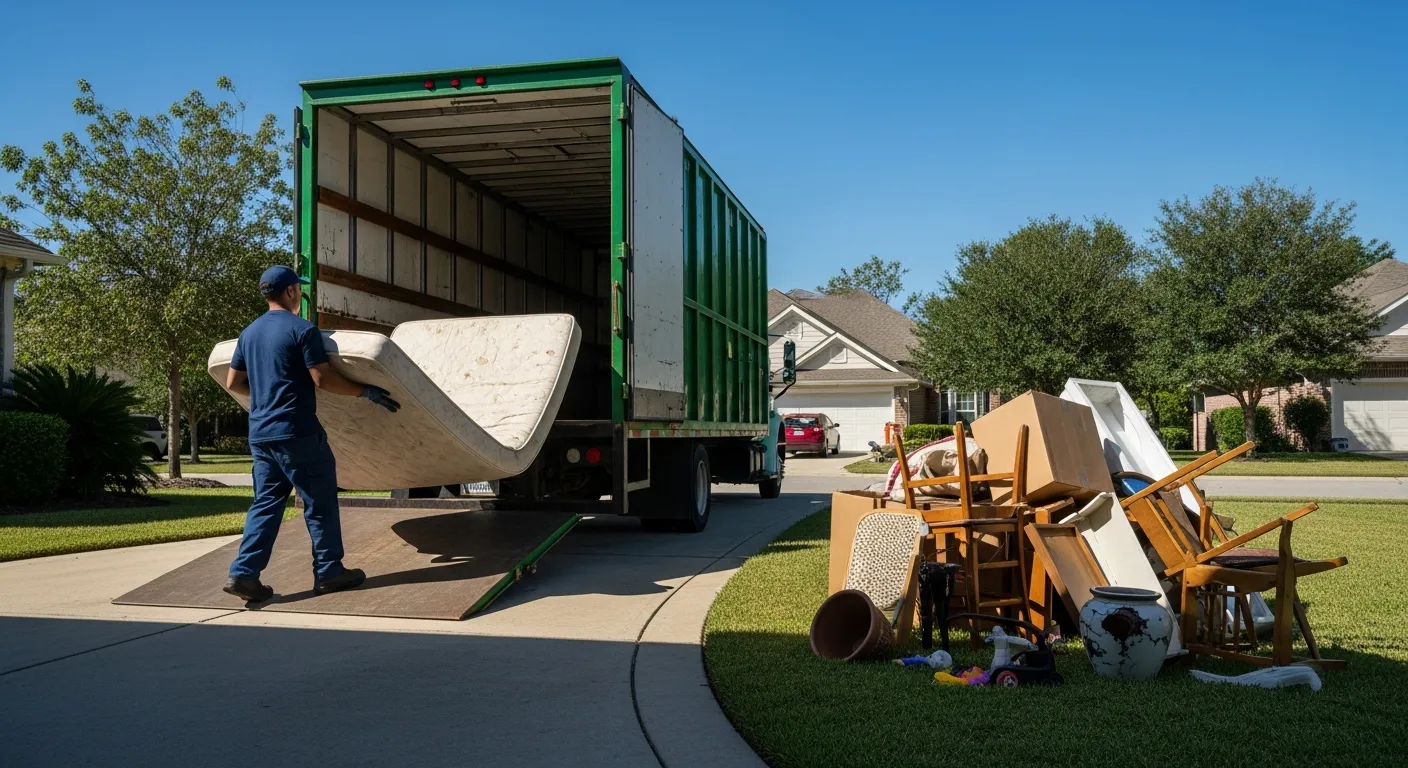
Junk removal is a book-it-now business
Junk removal has a distinctive tempo. Someone finally decides to deal with the garage, the storage unit, the estate cleanout, or the pile of debris from a renovation, and the moment they decide, they want it gone — ideally today. They search "junk removal near me," start dialing, and hire whoever answers, gives them a ballpark, and puts a truck on the calendar first. The customer isn't running a careful three-bid process; they want the mess gone and they'll book with the first competent company that picks up.
That makes the phone the entire conversion engine. A hauling company can have the cleanest trucks and the friendliest crews in town, but if the line rings to voicemail while the crew is elbow-deep in a basement cleanout, the same-day customer has already booked with the competitor who answered. As of July 2026, the junk removal companies that fill their trucks are the ones whose phone is answered every time, whose same-day slots get booked on the call, and whose after-hours calls get captured instead of dropped.
This guide covers the full automation stack for a junk removal and hauling business: 24/7 bilingual answering, volume-based quoting, same-day booking, truck dispatch and routing, payments and QuickBooks, reviews, and ad attribution. It maps to the Run with Jarvis platform, which folds all of it into one system.
Layer 1: 24/7 bilingual answering that books the same-day job
The foundation is KeyBot, the AI phone agent that answers on the first ring, all day and night, in English or Spanish. For junk removal, two properties matter most.
It's always on. Junk removal calls come at odd hours — someone doing a weekend cleanout, a property manager who needs a unit emptied before a Monday move-in, a homeowner who decided at 8 p.m. that the old appliances are going tomorrow. An AI that answers instantly at any hour books the jobs a voicemail box loses overnight. The after-hours economics are in the after-hours calls playbook, and why speed of answer wins the same-day customer is in the speed-to-lead guide.
It answers in parallel. Junk removal has predictable rushes — weekend mornings, the end of the month when leases turn over, the spring-cleaning and post-holiday surges. When five people call in the same twenty minutes, a human on one line holds one and loses four to busy signals. The AI answers all five at once, quotes each, and books each into an open window. That surge capacity is the subject of seasonal call volume management, and the net for any call that still slips is missed-call text-back.
The bilingual capability is standard equipment in this trade. Junk removal serves a broad customer base and is often staffed by Spanish-speaking crews, and an English-only line fumbles a real share of calls. The AI handles the whole call — quote, same-day booking, address — in whichever language the caller prefers. See bilingual Spanish answering. And if you're comparing this to a live answering service, AI vs. human answering service explains why an agent that books the pickup beats one that just takes a message.
Layer 2: Volume-based quoting — how junk removal actually prices on the phone
Junk removal is one of the few trades that can give a real over-the-phone estimate, because it prices by volume — how much of the truck the job fills. That's exactly the kind of structured quote an AI is built to handle. The AI captures what needs to go (furniture, appliances, yard debris, construction waste, a full cleanout), roughly how much of it there is (a few items, a garage, a whole house), and the complications that change the price — stairs, a second-floor apartment, heavy items like a hot tub or a piano, or a long carry from the back of the property.
From that, it gives the caller a realistic ballpark by truck fraction — an eighth, a quarter, a half, a full load — with the clear understanding that the crew confirms final pricing on site once they see the actual pile. That's how junk removal has always quoted; the AI just does it consistently on every call, at every hour, without the customer waiting for a callback. Getting an honest ballpark and a booked slot on the same call is what converts the same-day customer. The quoting-and-booking mechanics are in how AI appointment booking works.
The captured detail does double duty: it books the job and it tells the crew what to bring. A job flagged as a whole-house cleanout with stairs and heavy items gets the right truck and the right number of haulers, instead of a two-person crew showing up to a job that needed three and a bigger truck.
Layer 3: Same-day booking into real windows
Same-day is the value proposition of the entire category. A customer who wants their junk gone today and gets told "we'll call you back to schedule" is a customer who's already dialing the next company. The AI books directly into your available windows in real time through GetTimePad, so the caller who wants their garage emptied this afternoon gets an actual slot on the call, not a promise.
That real-time booking is what separates a company that captures same-day demand from one that leaks it. Because the slots are live, the AI never double-books a truck or promises a window that's already full — it books what's actually available. The case for booking on the call instead of playing phone tag is in online booking vs. phone calls, and the reminders that keep booked pickups from evaporating are in reduce no-shows with appointment reminders.
Layer 4: Truck dispatch and routing across a full day of pickups
A junk removal day is a sequence of stops, and the money is in how many you can complete — which comes down to routing and knowing where your trucks are. IntelliDrive provides the CRM, GPS truck tracking, and route optimization to sequence the day's pickups efficiently, slot a same-day add-on into the nearest truck's route, and give a waiting customer an accurate arrival window instead of an all-day "sometime between 8 and 5."
Tight routing directly raises truck utilization: less windshield time between stops means more pickups per truck per day, and more pickups per day is the whole revenue equation in a business with fixed truck and crew costs. When a customer calls to ask when the crew is arriving, your office answers from the live map instead of guessing, and you can text an updated window. The multi-truck dispatch mechanics are in CRM and dispatch software for multi-tech service businesses, and the case for handling more volume without adding office staff is in scaling without hiring.
Layer 5: On-the-spot payments and clean books
Junk removal collects at the point of service — the crew finishes, the customer sees the empty garage, and payment happens right there. IntelliDrive's POS and payment links let the crew take a card on the spot or send a link the customer pays from their phone, so nobody leaves a completed job chasing money. The payment-link mechanics are in get paid faster with payment links.
Bidirectional QuickBooks sync keeps the books aligned without re-keying each ticket — details in the QuickBooks sync guide — and chargeback defense protects card payments in a fast, on-site transaction where disputes occasionally surface. Running quotes, jobs, and invoices through one CRM and POS means every pickup is a complete record instead of a scribbled ticket and a separate accounting entry. For a high-volume, many-small-tickets business, that consolidation is what keeps the back office from drowning.
Layer 6: Reviews to win the search-driven jobs
A huge share of junk removal starts with a search — "junk removal near me," "same day junk pickup," "estate cleanout service" — and the company with the strongest, most current review profile wins the click and the call. IntelliDrive automates review requests after a completed pickup, turning a clean cleanout and a swept-up driveway into the reviews that win the next searcher. Because junk removal does so many jobs, the volume of review requests compounds fast, building a profile that outranks slower competitors.
On the Elite plan, that extends to AI-drafted review replies and Google Business Profile management, keeping the profile active for a business people find on a "who can haul this away today" search. The full playbook is in get more customer reviews, and the local-search angle is in the Google Business Profile guide.
Layer 7: Attribution for junk removal ad spend
Junk removal companies compete hard on Google Ads and Local Services Ads for high-intent terms. CallFlux, on the Pro plan, tells you which of that spend actually produced booked pickups. It uses Dynamic Number Insertion and gclid attribution to tie each call to its campaign and keyword, records and transcribes calls, and scores leads — so you can see which ads generate real jobs versus price-shoppers and out-of-area inquiries. In a category where clicks aren't cheap and margins per job are modest, knowing your true cost per booked pickup is what keeps the ad budget profitable. Details are in the call tracking and attribution guide, and the LSA specifics are in the Local Services Ads guide.
Mapping the plans to a junk removal business
Here's how the three Run with Jarvis tiers map to a junk removal and hauling operation. Every plan includes zero setup fees, unlimited users, and month-to-month terms.
| Plan | Price | Call minutes | Best for the junk removal company that... | Key capabilities for hauling |
|---|---|---|---|---|
| Core | $500/mo | 500 min ($0.45/min overage) | Needs 24/7 answering, volume quoting, and same-day booking for the whole operation | 24/7 AI receptionist EN/ES, volume-based quoting, same-day booking, GPS truck dispatch + routing, CRM, POS + on-site payments, QuickBooks sync, review automation, chargeback defense, AI follow-up, mobile app |
| Pro ⭐ | $750/mo | 1,000 min ($0.40/min overage) | Runs Google/LSA ads and wants to know what converts | Everything in Core plus call tracking & attribution (DNI, gclid, transcription, lead scoring, recording) |
| Elite | $1,200/mo | 2,500 min ($0.35/min overage) | Wants to actively grow and automate marketing | Everything in Pro plus AI growth: campaign builder, Google Business Profile management, AI review replies, LSA lead management, and the Jarvis AI Assistant |
High-volume junk removal companies take a lot of short calls, and weekend and month-end rushes can push a busy operation past 500 minutes, so the higher minute allotments on Pro and Elite frequently matter as much as the features. The plan-selection guide helps you match minutes to your call volume, and what AI operations actually cost compares it to staffing a phone through the rushes.
The same-day-capture math
The old way to catch same-day junk demand is to keep someone chained to the phone during business hours and hope they're free when the call comes in. But junk removal calls cluster — five in twenty minutes, then quiet — and a single person can only book one caller at a time. The other four, wanting a truck today, book with whoever answered them instead.
An AI receptionist changes that completely. It answers all five simultaneous callers, quotes each by volume, and books each into a live window, for a flat monthly rate instead of the payroll of a phone desk that's idle between rushes. For a business where the customer wants it gone today and books with the first company that says yes, parallel answering that closes the booking on the call is the highest-leverage tool available. The always-on-employee case is in what is an AI employee for service businesses.
Outbound follow-up: quotes and confirmations
Not every junk call books on the first try — sometimes a customer gets a ballpark, says they'll "figure out the timing," and goes quiet. Every plan includes AI outbound follow-up (not cold sales) for exactly this. It confirms scheduled pickups so trucks aren't rolling to no-shows, follows up on quotes that didn't book, and calls back leads that came in during a weekend rush. For a junk removal business, chasing the ballparks that went quiet is often the cheapest jobs you'll add all month. The mechanics are in AI outbound follow-up.
The metrics that tell you it's working
Once the stack is live, watch a few clean numbers. Start with booking rate — the share of inbound calls that turn into a scheduled pickup. Because the AI quotes and books on the call, this should rise sharply, and each booking is a filled truck slot.
Track same-day capture: how many callers who wanted a pickup today actually got booked today rather than lost to a callback. This is the number that most directly reflects whether you're winning the category's defining moment. Pair it with after-hours jobs captured, the overnight and weekend calls a voicemail box used to drop.
Watch pickups per truck per day, which tighter routing should raise — the core productivity metric in a business with fixed truck and crew costs. Track collection rate, which on-site POS and payment links should push toward 100%. On the Pro plan, watch cost per booked pickup by campaign so CallFlux attribution shows which ads actually produce jobs. The full ROI framework is in the AI receptionist ROI guide.
Anatomy of a same-day call, start to finish
Trace the call that fills a truck. It's Saturday, 9:15 a.m. A homeowner is mid-garage-cleanout, has a pile of old furniture, a broken treadmill, and bags of debris, and wants it gone before the afternoon. They search "junk removal near me" and start calling. Two of the numbers they dial ring to voicemail — the crews are already out on jobs.
Your AI answers on the first ring. It quickly figures out the scope: a garage's worth of furniture, a heavy treadmill, some bagged debris, one flight of stairs from the garage to the driveway. It gives an honest volume-based ballpark — roughly a half-truck, final price confirmed on site — and books a two-hour window that afternoon into a truck that's actually free, capturing the address and phone. The crew gets the job with enough detail to bring the right truck and a second hauler for the treadmill.
The companies whose lines went to voicemail that Saturday morning never got the job. In junk removal, the same-day customer books with the first company that answers and says yes, and the quality of the volume quote decides whether the crew shows up prepared. The quoting logic is in how AI appointment booking works; the rush-hour economics are in seasonal call volume management.
What junk removal owners ask before switching
"Can an AI really quote a junk job?" At the level junk removal actually quotes over the phone — by volume — yes. It captures what and how much and the complications, gives an honest truck-fraction ballpark, and books, with final pricing confirmed on site by the crew. That's the same quote your best phone person gives, on every call.
"What about the weekend and month-end rushes?" That's a core reason to switch. The AI answers in parallel, so five simultaneous callers all get quoted and booked instead of one held and four lost to busy signals. See seasonal call volume management.
"Can it actually book same-day, not just take a message?" Yes — it books into your live windows in real time, so a caller who wants it gone today gets an actual afternoon slot, not a callback. See online booking vs. phone calls.
"Will it lose me my Spanish-speaking customers?" The opposite — it handles the whole call in Spanish, which for a trade serving a broad customer base is a real share of jobs an English-only line would fumble. See bilingual Spanish answering.
Building the stack in order
A practical rollout for a junk removal business:
- Turn on 24/7 parallel AI answering first. This ends the busy signals during weekend rushes and the voicemail misses after hours. Get KeyBot answering EN/ES around the clock.
- Wire volume quoting and same-day booking so every call gets a ballpark and a real slot.
- Turn on truck dispatch and routing so the day's pickups stay tight and add-ons slot in.
- Run jobs and invoices through one CRM/POS with on-site payments and QuickBooks sync.
- Automate reviews to win the search-driven volume.
- Add attribution (Pro) to see which ads produce booked pickups.
The strength of one platform in junk removal is throughput: the AI that quotes and books the same-day call is the same system that routes the truck, collects on site, and syncs the books — no re-keying between a phone service, a scheduler, and an accounting app while the next rush of calls comes in. The case for one stack over stitched-together tools is in all-in-one vs. point solutions.
See the tiers against your own call volume at /pricing, or get in touch to plan a same-day-booking rollout.