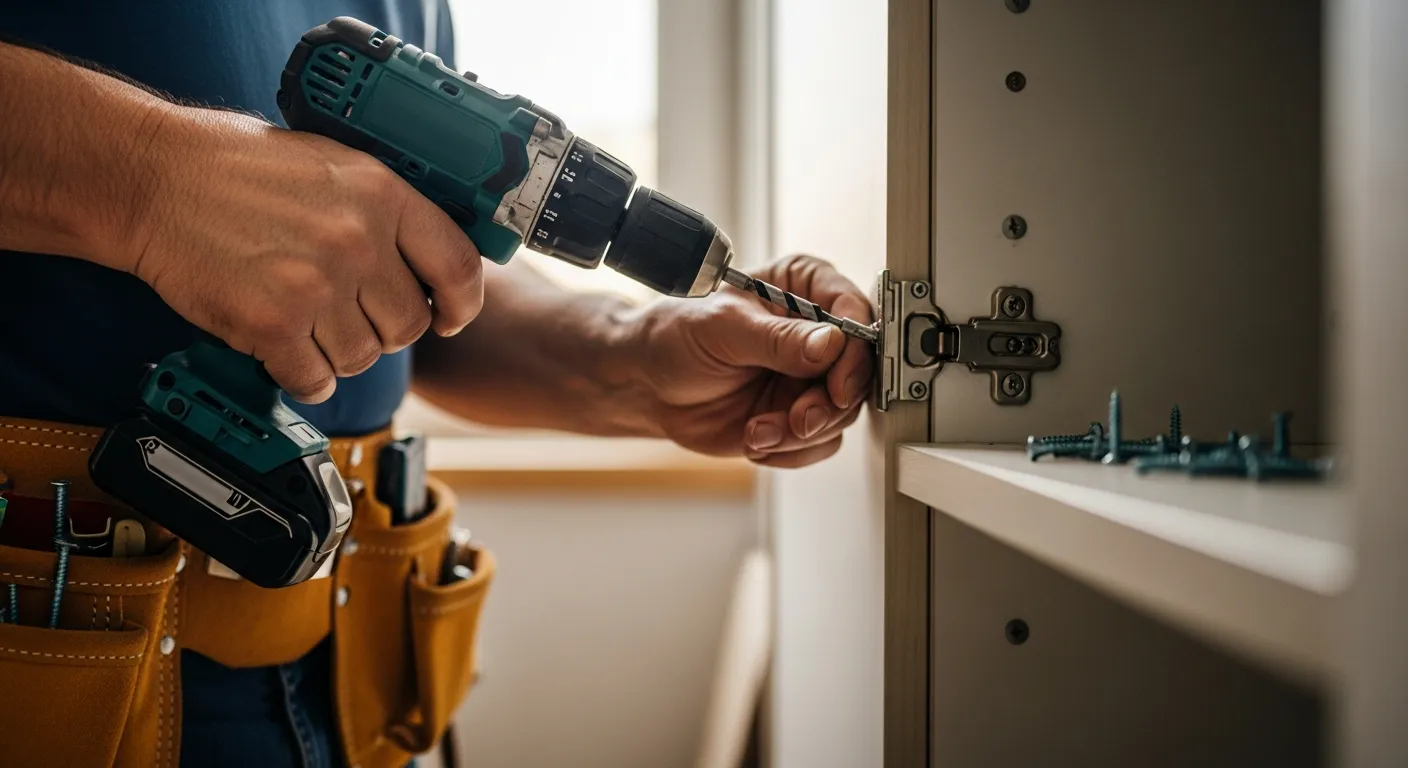
A handyman can't answer the phone with a drill in his hand
The defining problem of a handyman business is simple and brutal: the owner is almost always doing the work. He's on a ladder, under a sink, holding a level against a wall, running a saw — hands full, focus locked, in someone's home. And while he's working, the phone rings. He can't answer it without stopping the job, so it goes to voicemail. The customer on the other end, who wanted a small repair handled this week, doesn't leave a message and wait. They just call the next handyman on the list.
That's the leak that caps most handyman businesses. It isn't skill, and it isn't demand — there's endless demand for someone reliable who fixes the dozen small things every home accumulates. It's that a one-person or small-crew operation physically cannot both do the work and answer the phone, so every call that comes in during a job is a coin flip between voicemail and a lost customer. As of July 2026, the handymen who stay booked solid are the ones whose phone gets answered every time, whose jobs get booked while they keep working, and whose small tickets get billed and reconciled without stealing the evening.
This guide covers the full automation stack for a handyman business: 24/7 bilingual answering, fast booking of many small jobs, tight schedule density, payments and QuickBooks, reviews, and ad attribution. It maps to the Run with Jarvis platform, which puts all of it in one system so a small operation doesn't drown in tools.
Layer 1: 24/7 bilingual answering that lets you keep working
The foundation is KeyBot, the AI phone agent that answers on the first ring, all day and night, in English or Spanish. For a handyman, two properties do the heavy lifting.
It's always on — including while you're on a job. This is the single most valuable thing an answering service does for a handyman, because your busiest hours are also your work hours. Every call that comes in while you're installing a faucet gets answered and booked instead of dumped to voicemail, so you never again have to choose between finishing the job in front of you and catching the customer on the phone. It also catches the evening and weekend calls — homeowners who only get to their to-do list after work — that a voicemail box loses. The after-hours economics are in the after-hours calls playbook, and why answering speed decides who gets the job is in the speed-to-lead guide.
It answers in parallel. Even a solo handyman gets bursts — a few calls in the same hour, a wave after a neighborhood mailer or a good review lands. A person can only be on one call at a time, and for a handyman, that person is usually holding a tool. The AI answers every caller at once and books each, so a small burst doesn't turn into three lost jobs. That capacity is covered in seasonal call volume management, and the net for any call that still slips is missed-call text-back.
The bilingual capability matters for a neighborhood trade serving a broad customer base. The AI handles the whole call — booking, estimate scheduling, callback — in whichever language the caller prefers. See bilingual Spanish answering. And if you're comparing this to a live answering service, AI vs. human answering service explains why an agent that actually books the job onto your calendar beats one that just texts you a message to call back — because a callback means stopping work, which is the whole problem.
Layer 2: Booking many small jobs, fast
Handyman work is a specific shape: a high volume of small, well-defined jobs. Hang a TV, fix a running toilet, replace a light fixture, patch drywall, re-caulk a tub, install a ceiling fan, swap out a garbage disposal. Most of these are recognizable tasks with a rough time and a rough price, which makes them ideal for an AI to book cleanly. The AI captures the job type, the rough scope (one fixture or five, a small patch or a whole wall), the address, and the customer's timeline, then puts it on the calendar with enough detail that you show up with the right tools and the right materials.
That last part quietly saves a handyman real money. A job booked with clean detail — "replace two exterior light fixtures, customer has the fixtures" versus a vague "electrical thing" — means one trip with the right ladder and no mid-job run to the hardware store. The booking mechanics are in how AI appointment booking works, and the case for booking on the call instead of playing phone tag is in online booking vs. phone calls.
For the jobs that are too big or too vague to book blind — a bathroom remodel, "a bunch of stuff around the house," an unclear scope — the AI books an on-site estimate instead of guessing at a slot. That way small jobs book straight onto the calendar and bigger ones get a proper walkthrough, without you fielding the difference yourself while you're working.
Layer 3: Schedule density — the productivity engine of a handyman
A handyman's income is a function of how many jobs fit in a day, and that comes down to two things: how tightly the calendar is packed and how little time is lost driving between jobs. This is where a scheduling system earns its keep. Booking through GetTimePad against real availability means the calendar fills without double-bookings or awkward gaps, and IntelliDrive routing sequences the day so you're not crossing town twice for two jobs that were a mile apart.
For a business built on short jobs, that density is everything. Shaving thirty minutes of windshield time between two stops can be the difference between fitting a fifth job in the day or going home after four. Route optimization and a clean calendar turn the same working hours into more billable jobs — the multi-job scheduling and dispatch mechanics are in CRM and dispatch software for multi-tech service businesses. And because the calendar is full of scheduled slots, reminders keep them from turning into no-shows that blow a hole in the day — the mechanics are in reduce no-shows with appointment reminders.
Layer 4: Payments and books that don't eat your evening
The hidden tax on a handyman business is paperwork. A day of five small jobs is five invoices, five payments to chase, and five entries to reconcile — and doing that by hand at the kitchen table after a full day of work is how small operators burn out. IntelliDrive's POS and payment links collapse it: take a card on-site the moment the job's done, or text a link the customer pays from their phone before you've left the driveway. No invoices mailed, no checks chased, no "I'll pay you next week."
The payment-link mechanics are in get paid faster with payment links. Bidirectional QuickBooks sync then keeps the books aligned automatically, without re-keying every small ticket — details in the QuickBooks sync guide — and chargeback defense protects the card payments. For a business whose margins depend on the owner's time, automating the many-small-tickets back office is what keeps the paperwork from silently eating the evenings you should be resting or the calls you should be booking.
Layer 5: Reviews to become the neighborhood's go-to handyman
The best handyman business is a referral-and-reputation machine, because a trustworthy handyman who shows up and does clean work is exactly what people search for and recommend. Reviews are the currency of that reputation — the homeowner searching "handyman near me" or asking a neighborhood group calls the name with the most, and most current, reviews. IntelliDrive automates review requests after each completed job, and because a handyman does so many jobs, that review volume compounds fast into a profile that dominates local search.
On the Elite plan, that extends to AI-drafted review replies and Google Business Profile management, keeping your profile active and polished for a business people find and vet online before they call. The full playbook is in get more customer reviews, and the local-search angle is in the Google Business Profile guide.
Layer 6: Attribution for handyman ad spend
Many handymen run Google Ads or Local Services Ads and want to know whether that spend is producing jobs or just phone calls that go nowhere. CallFlux, on the Pro plan, tells you. It uses Dynamic Number Insertion and gclid attribution to tie each call to its campaign and keyword, records and transcribes calls, and scores leads — so you can see which ads produce booked jobs versus price-shoppers and out-of-area calls. For a small operation with a modest ad budget, knowing your true cost per booked job keeps you from pouring money into ads that don't convert. Details are in the call tracking and attribution guide, and the LSA specifics are in the Local Services Ads guide.
Mapping the plans to a handyman business
Here's how the three Run with Jarvis tiers map to a handyman operation. Every plan includes zero setup fees, unlimited users, and month-to-month terms.
| Plan | Price | Call minutes | Best for the handyman who... | Key capabilities for handyman work |
|---|---|---|---|---|
| Core | $500/mo | 500 min ($0.45/min overage) | Needs 24/7 answering, fast job booking, and a tight schedule for the whole operation | 24/7 AI receptionist EN/ES, small-job booking, on-site estimate scheduling, tight calendar + routing, CRM, POS + on-site payments, QuickBooks sync, review automation, chargeback defense, AI follow-up, mobile app |
| Pro ⭐ | $750/mo | 1,000 min ($0.40/min overage) | Runs Google/LSA ads and wants to know what converts | Everything in Core plus call tracking & attribution (DNI, gclid, transcription, lead scoring, recording) |
| Elite | $1,200/mo | 2,500 min ($0.35/min overage) | Wants to actively grow and automate marketing | Everything in Pro plus AI growth: campaign builder, Google Business Profile management, AI review replies, LSA lead management, and the Jarvis AI Assistant |
A busy handyman fields a surprising number of short calls, so even a solo operator can approach the Core minute allotment; a small crew often runs into the higher allotments on Pro and Elite. The plan-selection guide helps you match minutes to your call volume, and what AI operations actually cost puts it against the alternatives.
The answer-the-phone-yourself math
The old way a handyman handles calls is to answer them himself — which means either stopping work every time the phone rings (and losing the rhythm and the billable time on the job he's on) or letting it go to voicemail (and losing the caller to the next handyman). Both cost money. Stop for every call and you finish fewer jobs; let them ring and you book fewer jobs. There's no version of a working handyman answering his own phone that doesn't leak revenue somewhere.
An AI receptionist removes the trade-off entirely. You keep working, every call gets answered and booked, and it costs a flat monthly rate instead of your billable hours or your lost customers. For a business where the owner's time on tools is the entire product, an assistant that handles the phone so you never have to put the drill down is the single highest-leverage tool you can add. The always-on-employee case is in what is an AI employee for service businesses, and the grow-without-hiring angle is in scaling without hiring.
Outbound follow-up: repeat customers and unbooked estimates
A handyman's best growth channel is the customer he already served — the person whose faucet he fixed also has a list of ten other small things. Every plan includes AI outbound follow-up (not cold sales) that supports that. It confirms upcoming jobs so you're not driving to a no-show, follows up on estimates that haven't booked, and can re-engage past customers about the next item on their list. For a handyman, keeping the calendar full with repeat and follow-up work is often easier than winning new customers, and automated follow-up does it without adding to your day. The mechanics are in AI outbound follow-up.
The metrics that tell you it's working
Once the stack is live, watch a few numbers. Start with calls answered — specifically the calls that used to go to voicemail while you were working. That gap closing is the whole point, and every one of those recovered calls is a job you couldn't take before.
Track booking rate, the share of answered calls that become scheduled jobs, which should be high because the AI books on the call instead of texting you to call back. Pair it with jobs per day, the productivity number that tighter scheduling and routing should raise — the difference between four jobs and five is real money in a small-ticket business.
Watch no-show rate, which reminders should push down, and collection rate, which on-site POS and payment links should push toward 100% while killing the "I'll pay you later" that turns into never. On the Pro plan, watch cost per booked job by campaign so CallFlux attribution shows which ads actually produce work. The full ROI framework is in the AI receptionist ROI guide.
Anatomy of a handyman call, start to finish
Trace the call you almost always miss. It's 10:30 a.m. and you're on a ladder installing a ceiling fan, both hands busy, when your phone starts buzzing in your pocket. A homeowner two neighborhoods over has a running toilet, a loose stair rail, and a light fixture that needs replacing, and they want someone this week. They found your name and called — but you can't answer from the top of a ladder, so normally this goes to voicemail and they call the next handyman.
Instead, your AI answers on the first ring. It captures the three tasks, confirms the customer has the replacement fixture on hand, gets the address, and books a two-hour slot Thursday morning — fitting it into an open window near another job you already have that side of town, so the route stays tight. It texts the customer a confirmation. You never came off the ladder, never lost your rhythm, and finished the fan on schedule — and you picked up a three-task job you'd have lost every other week.
That's the whole model. A handyman's calls come in exactly when he can't take them, and an assistant that answers and books while he keeps working turns the missed-call leak into a booked calendar. The booking logic is in how AI appointment booking works; the burst-capacity angle is in seasonal call volume management.
What handyman owners ask before switching
"I'm a small operation — is this overkill?" It's the opposite. The smaller you are, the more the phone problem hurts, because you're the one on the tools and the one who'd answer the phone, and you can't be both. An assistant that answers and books while you work is exactly what a small operation needs to stop leaking calls without hiring an office person.
"Can an AI actually book my kind of jobs?" Most handyman jobs are recognizable tasks with a rough time and scope, which the AI captures and books cleanly. The big or vague ones it books as an on-site estimate instead of guessing. Either way you show up prepared. See how AI appointment booking works.
"Will it keep my schedule tight?" Yes — it books into real availability and routing sequences the day, so you fit more short jobs in with less driving between them. See CRM and dispatch software.
"Will it lose me my Spanish-speaking customers?" No — it handles the whole call in Spanish, which for a neighborhood trade is a real share of the jobs. See bilingual Spanish answering.
Building the stack in order
A practical rollout for a handyman business:
- Turn on 24/7 parallel AI answering first. This ends the missed calls while you're on the tools and after hours — the single biggest leak in a handyman business. Get KeyBot answering EN/ES around the clock.
- Wire job booking and estimate scheduling so small jobs book straight to the calendar and big ones get a walkthrough.
- Tighten the calendar and routing so more short jobs fit in a day.
- Turn on on-site payments and QuickBooks sync so the paperwork stops eating your evenings.
- Automate reviews to become the neighborhood's go-to name.
- Add attribution (Pro) to see which ads produce booked jobs.
The strength of one platform for a handyman is that a solo or small operation gets a full back office — answering, booking, scheduling, payments, books, reviews — without hiring anyone, all in one system instead of five apps. The case for one stack over stitched-together tools is in all-in-one vs. point solutions.
See the tiers against your own call volume at /pricing, or get in touch to plan a rollout that keeps you on the tools instead of on the phone.