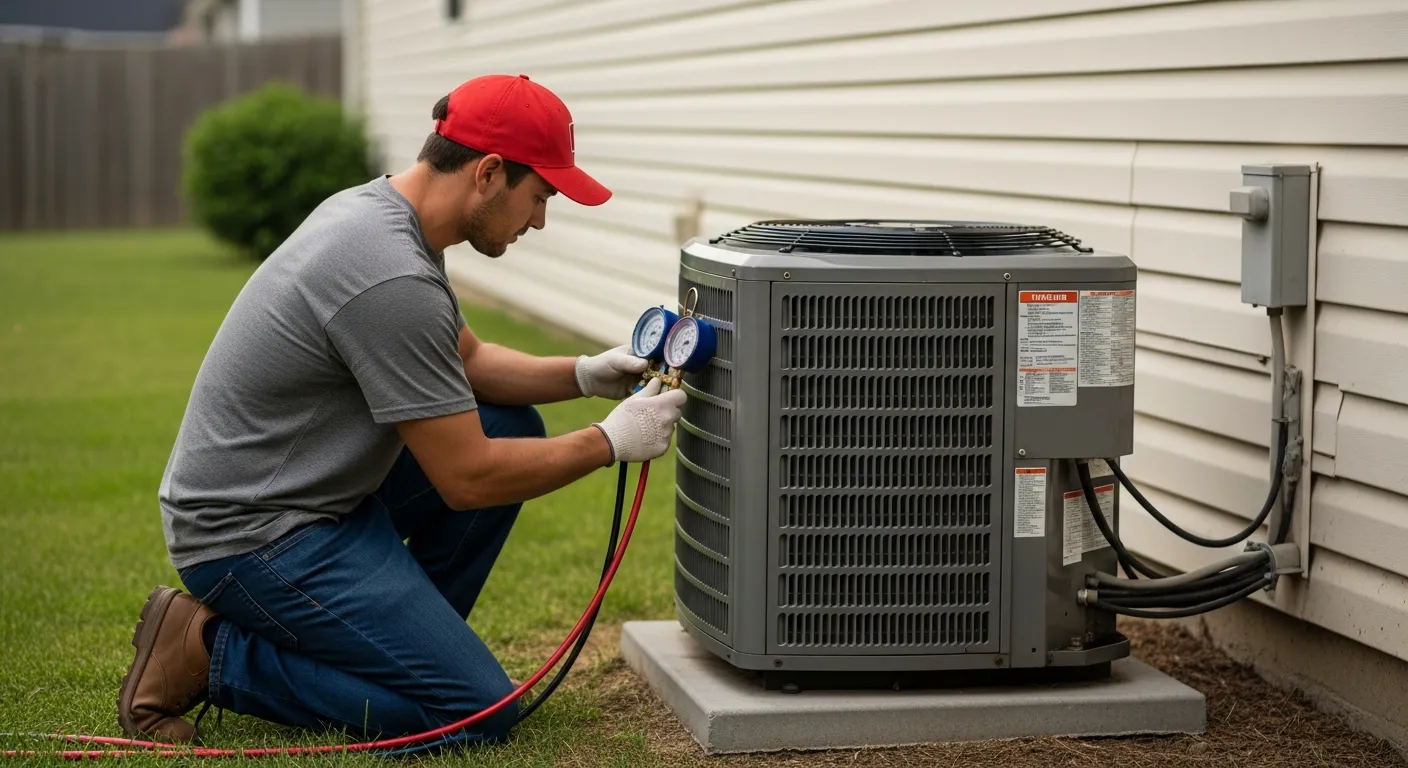
HVAC is a demand-spike business, and the phone is the choke point
Most trades lose a steady trickle of revenue to missed calls. HVAC loses it in floods. The demand curve for heating and cooling isn't a gentle line — it's a series of cliffs tied to weather. The first 98-degree afternoon of summer, the first hard freeze of winter, the humid week that finally pushes a marginal compressor over the edge: on those days the phone rings three or four times its normal rate, and every one of those calls is a homeowner who is uncomfortable, motivated, and ready to book the first contractor who answers. As of July 2026, the technology to answer every one of those calls — on the first ring, at any hour, without hiring a seasonal phone crew you'll lay off in October — is mature, affordable, and increasingly the line between HVAC shops that grow through the busy season and shops that just survive it.
This is the vertical deep-dive on the complete HVAC answering and operations stack: what the layers are, what each one does for a heating-and-cooling business specifically, how a contractor handles seasonal spikes and after-hours emergencies without burning out the office, and how it all maps to Run with Jarvis plan tiers. It's written for the residential and light-commercial HVAC contractor — the shop where the owner or a single office manager is fielding calls while techs are on rooftops.
Why HVAC feels the missed-call problem differently than other trades
Every service business should answer its phone. HVAC has three specific pressures that turn "should" into "the difference between a good year and a flat one."
Demand is seasonal and spiky, not steady. A plumber's emergencies arrive roughly year-round. An HVAC contractor's arrive in concentrated bursts driven by weather. Staffing the phone for the July peak means overpaying all spring; staffing for the average means drowning during every heat wave. This structural mismatch is exactly what automation is built to solve — capacity that scales to the spike and costs nothing extra in the trough.
The emergency jobs are the profitable ones, and they come at night. A no-heat call at 11 PM in January and a no-AC call at 9 PM in July are the highest-urgency, best-margin work an HVAC shop does — and they arrive precisely when a human answerer is least available and most expensive. A homeowner sweating through a broken AC does not leave a voicemail and wait; they call the next result. After-hours capture isn't an edge case for HVAC, it's a core product line. Our after-hours calls playbook covers the general discipline; for HVAC, the stakes on each after-hours call are unusually high.
The office is the bottleneck, and burnout is real. During a surge, one or two office people are simultaneously booking maintenance, triaging emergencies, dispatching techs, chasing parts, and calming anxious customers. Something gives — usually the phone. Small firms dominate this trade, and you can review current small-business employment figures at the U.S. Bureau of Labor Statistics (bls.gov), but the pattern on the ground is familiar: most residential HVAC shops run lean, and "just hire more front-desk staff for two weeks in July" is neither easy nor cheap.
Automation attacks all three at once: the phone is answered instantly, in parallel, at any hour and any volume, without pulling anyone off dispatch and without a seasonal hiring gamble. That's the first layer. The other layers make sure the answered call becomes a booked job, a dispatched tech, a paid invoice, and a review that feeds next season's demand.
The layers of the HVAC automation stack
Layer 1: 24/7 AI answering and emergency triage — KeyBot
The foundation is an AI receptionist that answers every call on the first ring, around the clock, in English and Spanish. For HVAC that's KeyBot, the answering layer of the Run with Jarvis platform. It handles the intake that matters for heating and cooling: what's the symptom (no heat, no cool, no airflow, strange noise, water leak), what's the equipment and roughly how old, what's the address, and how urgent is it — then quotes your diagnostic or service-call fee and books the visit.
The triage step is what separates an HVAC-aware answering service from a generic message-taker. Not every call is a 2 AM emergency, and not every "it's not working" is the same job. An AI receptionist that handles lead intake and qualification can consistently sort a routine "my AC isn't as cold as it used to be" (book for this week) from a "my elderly mother has no heat and it's 20 degrees" (flag for priority dispatch or on-call routing) — on every call, at every hour, without the judgment drift that happens when a tired human triages at midnight during a cold snap.
The bilingual point is significant for this trade too: in most metro markets a real share of HVAC service calls come in Spanish, and a shop whose phone handles both languages natively books demand its competitors quietly turn away. If you want to weigh the AI-versus-human answering question directly, our AI vs human answering service comparison lays out the trade-offs, and the ROI math on an AI receptionist builds the general business case that HVAC's seasonal economics only sharpen.
Layer 2: Booking that closes the call — GetTimePad
An answered emergency that ends with "someone will call you back to schedule" is a half-win at best, and during a heat wave it's often a lost one. The second layer, GetTimePad, closes the loop: the visit goes on the calendar during the call, with SMS confirmations sent to the customer. Booking in the call matters for the same reason answering on the first ring does — every extra step between "yes, come fix it" and "you're scheduled" is a window for a nervous customer to keep dialing.
For an HVAC contractor, the calendar is also an operational instrument. A summer day of eight service calls sequenced sanely across a metro area is a very different day from eight calls booked at random and backtracked all afternoon in traffic. Scheduling, intake forms, and customer records in one place mean the tech arrives already knowing the symptom, the equipment, the address, and the quoted fee. The mechanics of moving a caller from question to confirmed slot are in our companion guide on how AI appointment booking works. And because maintenance-plan no-shows are a real drain in this trade, the reminder cadence covered in our reduce no-shows guide sits directly on top of this layer.
Layer 3: CRM, invoicing, payments, and multi-tech dispatch — IntelliDrive
The third layer is where the HVAC stack stops being a front office and becomes a business system. IntelliDrive is the CRM + POS layer: unified customer and equipment records, invoicing and payment links, inventory, technician dispatch, and QuickBooks/Square sync.
Each of those maps to a specific HVAC headache:
- Technician dispatch is the one that pays for itself fastest during a spike. When ten emergency calls land in an afternoon, "who's closest to the no-AC on the east side, and who's already got the right capacitor on the truck?" has to be a system decision, not a frantic group text. For shops running two or more trucks, our CRM and dispatch guide for multi-tech businesses goes deep on exactly this layer.
- Invoicing and payment links end the "I'll mail a check" ritual. The tech finishes the repair, the invoice exists, the customer pays by link on the spot — and outstanding-balance reminders chase whatever lingers. Collecting at the curb, especially on a big compressor or system-replacement ticket, is a cash-flow difference you feel immediately.
- Equipment and customer history turns every repeat visit into an informed one. Knowing the model, the install date, the last capacitor you replaced, and the maintenance-plan status means the tech isn't rediscovering the system from scratch — and the office can proactively pitch a replacement on aging equipment.
- Inventory keeps a booked emergency from dying at the customer's house because the part wasn't on the truck. Capacitors, contactors, motors, and refrigerant are real money riding around town, and knowing what's on hand is the difference between a same-visit fix and a return trip.
- QuickBooks / Square sync means the books reflect the season's reality without Sunday-night data entry.
The strategic point isn't any single feature — it's that this layer shares records with the layers above it. The call KeyBot answered, the visit GetTimePad booked, and the invoice IntelliDrive collected are one customer story, not three exports. That integration argument — one platform versus a stack of point tools duct-taped together — is examined honestly in our all-in-one vs point solutions comparison.
Layer 4: Call tracking and attribution — CallFlux
The final layer answers the question every HVAC contractor asks when the season ends: which marketing actually produced booked jobs? CallFlux is the call-tracking layer — ad-source attribution, call recording and transcription, conversion analytics, and campaign ROI dashboards.
HVAC marketing is uniquely attribution-hungry because spend is seasonal and expensive. Contractors pour budget into paid search, local service ads, and seasonal tune-up promotions right when cost-per-lead peaks, and two campaigns can deliver the same call count while one delivers triple the booked revenue. Without per-source tracking tied through to jobs, you fund both forever — and worse, you can't tell whether the heat-wave surge came from your ads or just the weather. Attribution separates the demand you paid for from the demand you'd have gotten anyway, which is the single most valuable thing a seasonal advertiser can know. The full discipline is laid out in our call tracking and attribution guide.
The layer above the layers: Jarvis AI Brain
On the top tier, the Jarvis AI Brain sits across all four layers as a command center: natural-language commands, an autonomous workflow engine, revenue optimization, and proactive recommendations. Practically, it's the difference between owning four connected systems and being able to ask your business questions: "How many emergency calls did we book last night?" "Which techs are overbooked tomorrow?" "Show maintenance-plan customers whose systems are over twelve years old." For an owner who has spent years assembling those answers from tabs and gut feel, this layer changes how the busy season feels.
Mapping the stack to plan tiers
Here's how the four layers land on Run with Jarvis pricing, and which HVAC contractor actually needs each tier:
| Plan | Price | AI minutes | What it includes | Right for |
|---|---|---|---|---|
| Core | $500/mo | 500 ($0.45/min overage) | KeyBot 24/7 bilingual answering + GetTimePad booking, SMS confirmations, plus IntelliDrive CRM/POS: invoicing, payment links, inventory, multi-tech dispatch, QuickBooks/Square sync | Solo shops and multi-truck operations alike — the complete operations system, from answered call to collected payment |
| Pro | $750/mo | 1,000 ($0.40/min overage) | Everything in Core + CallFlux: ad attribution, call recording and transcription, AI lead scoring, conversion analytics, ROI dashboards | Contractors spending seriously on seasonal ads/LSA who need to know what converts |
| Elite | $1,200/mo | 2,500 ($0.35/min overage) | Everything in Pro + AI marketing and the Jarvis AI Brain: AI campaign builder, Google Business Profile management, natural-language commands, autonomous workflows | Owners running the whole operation as one system and managing by question, not by tab |
Every plan is month-to-month — zero setup fees, unlimited users, no long-term contract, and no per-call fees; overage is per-minute only, and the rate gets cheaper on the higher tiers.
Two honest buying notes. First, the tiers are cumulative — you build up, not sideways — and in practice that's the right order: attribution without booking data is trivia, and a workflow engine with no invoices to work has nothing to do. Second, match the tier to your bottleneck, not your ambition. A small shop drowning in July missed-calls gets far more from $500 well-configured than from $1,200 half-configured; a four-truck operation burning ad budget with no idea what converts should not stop below $750. The broader budget framework — minutes, overages, and payback — is in our companion piece on what AI operations actually cost in 2026, and if you're stuck between two tiers, how to choose an AI receptionist plan walks the decision.
A word on minutes, because seasonality makes it the question every HVAC contractor asks. AI call minutes are the metered part of every plan — 500 on Core, 1,000 on Pro, 2,500 on Elite — and here's the math that matters for a spiky business. A typical HVAC intake call (symptom, equipment, address, quote, booking) runs a few minutes of talk time. Call that 4 minutes average. On Core's 500 minutes that's roughly 125 fully-handled calls in a month before overage — and even if a heat wave pushes you past it, the overage is $0.45 per minute, or about $1.80 for that extra booked emergency. Pro's 1,000 minutes cover roughly 250 calls at a cheaper $0.40/min overage, and Elite's 2,500 minutes cover roughly 625 at $0.35/min — the per-minute rate falls as you move up, not the other way around. An after-hours no-AC job worth several hundred dollars in labor and parts, captured for under two dollars of overage, is the happiest line item on your invoice. The practical guidance: don't buy a tier for its minute allotment. Pick the tier whose systems match your operation, run a normal month and a peak month, and let real usage tell you if you're sized right. A shop that blows through its minutes in July isn't overpaying — it's answering surge volume that used to hit voicemail, which is the entire point.
A day in the life: before and after a heat wave
Before — first 95-degree Monday of the summer, two-truck residential shop.
7:10 AM: Three no-AC calls already; the office manager is one person and the phone is a hold queue by 7:30. 8:00 AM: Two callers who couldn't get through have already booked a competitor. 10:30 AM: The manager is triaging, booking, and dispatching simultaneously and has stopped answering the phone to keep the calendar from collapsing. 1:00 PM: A tech texts asking where he's going next; the answer takes four minutes to sort because two jobs got double-booked in the chaos. 4:00 PM: The manager starts callbacks on the voicemails from this morning — half have moved on, and the ones who haven't are annoyed. 8:30 PM: A no-cool emergency comes in after hours; it goes to voicemail because there's no one left to answer, and it's gone by morning. 10:00 PM: Invoicing hasn't happened; three of today's jobs are unbilled, and nobody remembers whether the Ramirez system-replacement quote went out. The ad dashboard shows a spike in clicks, and the owner assumes — but doesn't know — it drove today's flood.
After — the same Monday on the full stack.
7:10 AM: All three morning no-AC calls are answered on the first ring in parallel, quoted, and booked, with SMS confirmations sent. The office manager learns about them from the calendar, not a voicemail backlog. 8:00 AM: The calls that would have gone to a competitor's phone are already on the schedule. 10:30 AM: The manager isn't triaging by hand — the system sorted routine from urgent, flagged two true emergencies for priority dispatch, and the dispatch view shows every tech's next stop. 1:00 PM: No "where do I go next" text; the tech's route is on his screen with the symptom and equipment attached. 4:00 PM: No callback roulette — the morning's overflow was captured and scheduled the first time. 8:30 PM: The after-hours no-cool emergency is answered, quoted at the correct evening rate, and booked while the office is closed. 10:00 PM: Invoices went out as payment links when jobs closed; several are already paid, stragglers are on an automated reminder cadence, and CallFlux shows that six of today's booked jobs came from LSA and the paid-search campaign booked one — so next week's budget quietly gets smarter. The morning after, a review request goes out to every completed job.
Nothing in the "after" required the office manager to become a software person. The change is that the phone, the calendar, the dispatch board, the invoice, and the ad report stopped being five competing chores during the worst two weeks of the season and became one system that scales with the weather.
Rolling it out before the season hits
A realistic adoption path for a working HVAC shop — ideally done in the shoulder season, not mid-heat-wave:
- Weeks 1 — answering and booking. Turn on KeyBot and GetTimePad, load your services, diagnostic fees, after-hours rates, and emergency-triage rules, and forward the lines. Listen to the first days of calls and tighten the intake and triage script where your market's symptoms and phrasing differ from what you expected.
- Week 2 — money and dispatch. Stand up IntelliDrive: import customers and equipment history, connect QuickBooks or Square, switch new jobs to payment links, and bring your techs onto the dispatch view. Don't backfill years of history under deadline — run new work on the new rails and migrate old receivables as reminders, not data entry.
- Week 3 — attribution. Point tracking numbers at your ad sources and seasonal promos, and let CallFlux accumulate two to three weeks of data before you touch spend. Reallocating an HVAC budget on four days of calls is astrology; attribution rewards patience.
- Week 4 — follow-up and reviews. Turn on the outbound follow-up cadence — post-visit review requests, maintenance-plan renewals, and reactivation of aging-equipment customers. Reviews earned in July feed the demand you'll answer next July; our get-more-reviews guide covers the mechanics.
From there, review one number per layer weekly: answer rate, booked-job count, days-to-payment, and cost per booked job by source. Small-business technology guidance from the SBA (sba.gov) points the same direction — adopt in stages, measure as you go, and let each stage justify the next. When those four numbers move the right way through a full season, the stack has paid for itself several times over, and Elite becomes the natural next step because you'll have a season of real data worth asking questions of.
Related reading
Go deeper on each layer: how AI appointment booking works, CRM and dispatch for multi-tech shops, call tracking and attribution, and the after-hours calls playbook. For the buying decision, compare all-in-one vs point solutions. Ready to see it run? Check pricing or book a demo and watch the stack answer a no-AC emergency end to end.